Kettlebell Workout
for Beginners6 Moves and a 3-Day Plan
A kettlebell workout for beginners: the 6 moves to learn first, how to swing with good form, what weight to start with, and a simple 3-day plan for women.
 By Wellio
You bought a kettlebell because it looked like the simplest way to train at home. Then you watched a few videos, saw everyone swing it differently, and started wondering whether your back should feel like that the next morning.
Kettlebells are a great tool, and easy to use badly. The good news: six moves cover your whole body, and a moderate bell takes you further than you'd expect.
Below we cover what the research actually says about kettlebell training, the six moves with clear cues, a detailed swing breakdown, how to choose your first weight, a 3-day plan, how to progress, and how to keep your back, grip and living room safe.
What does kettlebell training actually do?
The research is encouraging but modest.
| Study | Who | What they found |
|---|---|---|
| Lake and Lauder 2012, Journal of Strength and Conditioning Research | 21 healthy young men, 6 weeks, twice a week | Kettlebell swings improved maximal squat strength (about 10% across groups) and jump height (about 20%), with results similar to jump squat training |
| Otto and colleagues 2012, Journal of Strength and Conditioning Research | 30 healthy young men, 6 weeks | Both kettlebell training and Olympic weightlifting improved strength and jump height, but weightlifting improved squat strength more |
| Jay and colleagues 2011, Scandinavian Journal of Work, Environment and Health | 40 adults in jobs with high rates of pain, 85% women | 8 weeks of kettlebell training 3 times a week reduced neck, shoulder and low back pain compared with controls and improved low back strength, but didn't improve aerobic fitness |
| Brandt and colleagues 2025, Journal of Functional Morphology and Kinesiology | 38 club volleyball and basketball players (9 women), 6 weeks, not randomized | Kettlebell training improved jump performance; body fat and muscle mass didn't change |
| Meigh and colleagues 2019, BMC Sports Science, Medicine and Rehabilitation | Scoping review of 99 publications | Effects were usually trivial to small, studies were mostly small and low quality, and there are no authoritative guidelines for prescribing kettlebells |
Most of this research is small, short and in young men, and the one trial with mostly women focused on pain rather than muscle. Kettlebells build real strength and power, but they aren't magic.
The 6 kettlebell exercises to learn first
These six moves train every major muscle group. Learn them in this order, because each one builds the skill for the next.
| Move | What it trains | Main cue |
|---|---|---|
| Deadlift | Glutes, hamstrings, back | Push your hips back, flat back, stand up by squeezing your glutes |
| Goblet squat | Legs, glutes, core | Hold the bell at your chest, sit down between your heels, chest up |
| Swing | Glutes, hamstrings, back, grip, heart and lungs | A fast hip hinge: snap your hips forward and let the bell float |
| Single-arm row | Upper back, lats, arms | One hand on a bench or chair, pull the bell to your hip |
| Overhead press | Shoulders, arms, core | Squeeze your glutes, press straight up, bicep by your ear |
| Suitcase or farmer's carry | Core, grip, posture | Walk tall with the bell at your side, don't lean |
For the deadlift, the full setup is in our guide on how to deadlift for beginners; the kettlebell version is the easiest place to start.
Goblet squat
Hold the bell by the horns (the sides of the handle) close to your chest. Feet a little wider than hip-width, toes slightly out. Sit down between your heels as low as you comfortably can with your chest up and heels on the floor, then stand. Your elbows can brush the inside of your knees at the bottom.
Single-arm row
Put one hand and knee on a sturdy bench or chair, or stagger your stance and rest one hand on a table. Let the bell hang under your shoulder. Pull it toward your hip, keeping your elbow close to your body, then lower slowly. Do all reps on one side, then switch.
Overhead press
Clean the bell to your shoulder (or simply lift it there with two hands). The bell rests on the back of your forearm, wrist straight. Squeeze your glutes and brace your stomach, then press straight up until your arm is locked out, bicep near your ear. Lower under control. If your lower back arches a lot, try it half-kneeling or use a lighter bell.
Kettlebell swing form: how to swing without hurting your back
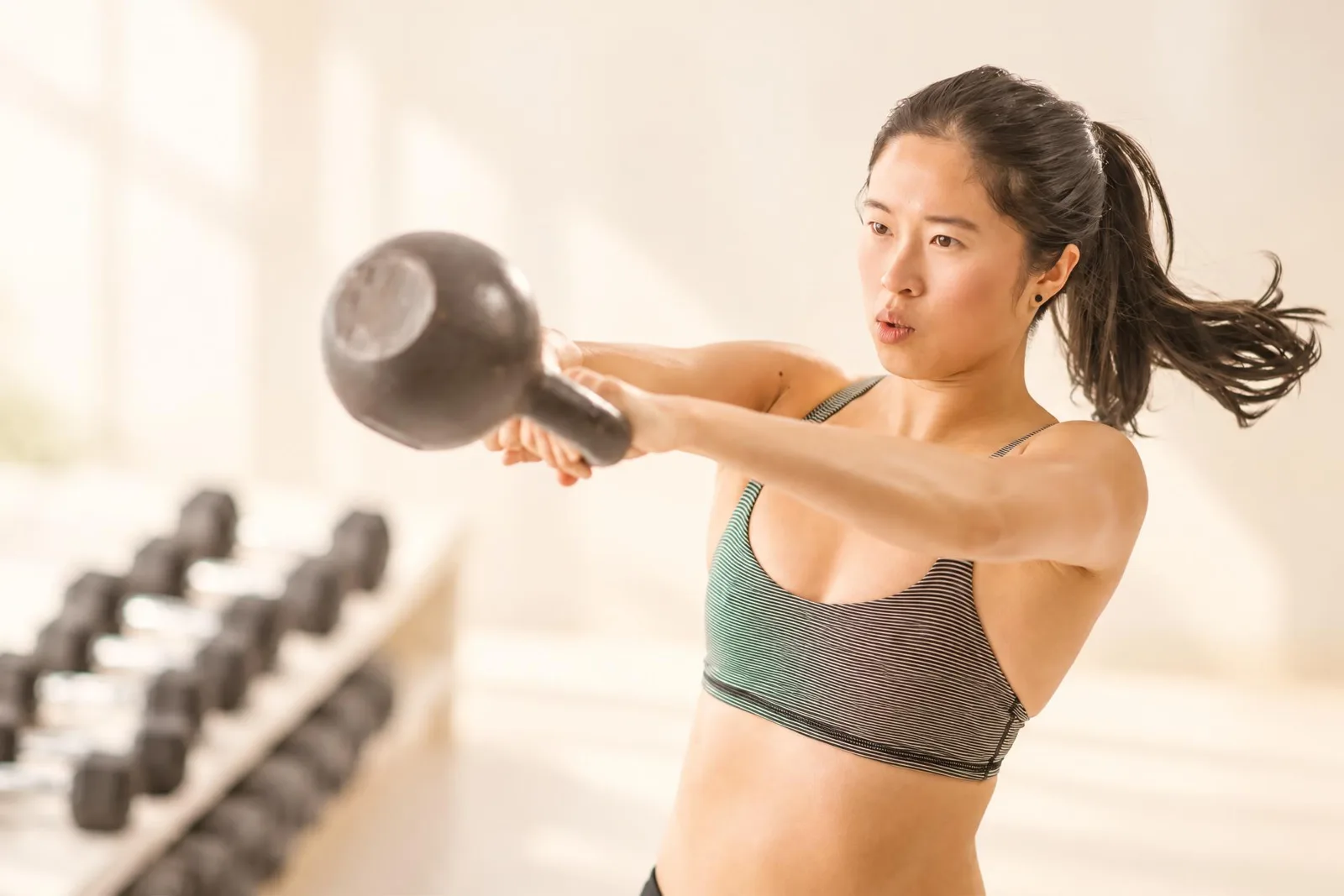
If you remember one thing, make it this: the swing is a hip hinge, not a squat and not an arm exercise. Your hips create the power. Your arms are just ropes attached to the bell.
Before you swing, make sure you can do 2 sets of 8 to 10 kettlebell deadlifts with a flat back. Many coaches teach the deadlift first; it isn't a research rule, but it makes the swing much easier to learn.
Step by step
- Set up. Place the bell about a foot in front of you. Feet a little wider than hip-width. Hinge back and grab the handle with both hands, tilting the bell toward you.
- Hike it back. Like a football snap, pull the bell back between your legs, high up near your groin, with your forearms touching your inner thighs. Your back stays flat.
- Snap your hips. Drive your hips forward hard and stand tall, squeezing your glutes. The bell floats up to about chest height. You don't lift it with your arms.
- Stand tall at the top. Body in a straight line, knees straight but not locked, ribs down. Don't lean back.
- Let it fall, then hinge. Let the bell drop. Wait until your forearms are about to touch your hips, then hinge back and let it travel between your legs again.
- Breathe. A sharp exhale as you snap your hips forward works for most people.
- Park it safely. To stop, let the bell swing back one last time and set it down in front of you, the same way you picked it up.
Common swing mistakes
| Mistake | What it looks like | Fix |
|---|---|---|
| Squatting the swing | Knees bend a lot, hips drop low | Think "hips back," not "sit down"; practice with a wall a few inches behind you and tap it with your butt |
| Lifting with your arms | Bell rises slowly, shoulders burn | Relax your arms; drive harder with your hips |
| Leaning back at the top | Back arches, ribs flare | Finish like a plank standing up: glutes tight, ribs down |
| Rounding your back at the bottom | Spine curls as the bell goes back | Keep the bell high between your legs, use a lighter bell, shorten the set |
| Swinging too high | Bell goes overhead | Chest height is enough for this style of swing |
Start with sets of 8 to 10 swings and rest until your breathing settles. Stop the set as soon as your form gets sloppy. Swings feel like cardio, so it's easy to push past good form chasing a number.
What weight kettlebell should a woman start with?
This is the most common beginner question, and the honest answer is "it depends." There's no research-based starting weight for women. What follows is common coaching practice to help you choose.
| Use | Common starting weight for women | If that's too easy |
|---|---|---|
| Presses, rows, beginners with no lifting history | 6 to 8 kg (13 to 18 lb) | 10 to 12 kg (22 to 26 lb) |
| Deadlifts, goblet squats, swings | 8 to 12 kg (18 to 26 lb) | 14 to 16 kg (31 to 35 lb) |
| Women who already lift regularly | 12 kg for swings and squats, 8 kg for presses | 16 kg for swings, deadlifts and squats |
If you can buy only one bell
Pick the weight for deadlifts, squats and swings, often 12 kg (26 lb), since those are the moves you'll do most. If it's too heavy to press, use a lighter dumbbell for presses. A common pair later is 8 kg and 12 kg.
How to check your choice
Do a set of 10 goblet squats. If you could easily do 10 more, the bell is light for that move. If you can't finish 8 with good form, it's heavy. Aim to stop most sets with about 2 to 3 good reps left.
Kettlebell workout for beginners: a 3-day full body plan
Do this 2 or 3 days a week with a rest day between sessions, about 30 to 40 minutes each. The sets, reps and order are common beginner coaching choices.
Warm-up (5 minutes)
Two minutes of easy movement (marching, step-ups, a brisk walk), then 10 bodyweight squats, 10 hip hinges with your hands on your hips, and 5 light deadlifts. See our guide on how to warm up before lifting for more options.
Day 1: Strength
| Exercise | Sets | Reps | Rest |
|---|---|---|---|
| Kettlebell deadlift | 3 | 10 | 60 to 90 sec |
| Goblet squat | 3 | 8 to 10 | 60 to 90 sec |
| Single-arm row | 3 | 8 to 10 per side | 60 sec |
| Overhead press | 2 | 6 to 8 per side | 60 sec |
| Suitcase carry | 2 | 30 sec per side | 45 sec |
Day 2: Swing and conditioning
| Exercise | Sets | Reps | Rest |
|---|---|---|---|
| Kettlebell deadlift (warm-up sets) | 2 | 8 | 45 sec |
| Two-hand swing | 5 to 8 | 10 | Until breathing settles, about 45 to 90 sec |
| Goblet squat | 2 | 10 | 60 sec |
| Farmer's or suitcase carry | 3 | 30 sec | 45 sec |
Weekly schedule
- 2 days a week: Day 1 on Monday, Day 2 on Thursday.
- 3 days a week: Day 1 Monday, Day 2 Wednesday, Day 1 again Friday. On the second Day 1, swap the deadlift for a single-leg deadlift (hold a wall if needed) and press half-kneeling for variety.
If you're brand new to the swing, replace swings with deadlifts in weeks 1 and 2 and add swings in week 3.
How to progress with kettlebells
The challenge with kettlebells is that the jump between bells is big: often 4 kg (about 9 lb). That's a lot more than the small steps you'd take with dumbbells or a barbell. So progress in this order, which is a common coaching approach.
- Add reps. Work from 8 up to 12 reps on squats, deadlifts and rows.
- Add a set. Go from 2 to 3 sets, or from 5 to 8 rounds of swings.
- Go single-arm or single-leg. One-arm swings, single-leg deadlifts and one-arm rows make the same bell much harder.
- Then go heavier. When you can do the top of your rep range for all sets with good form, it's time for the next bell.
The principle is the same as with any weights: do a little more over time. We explain it in detail in our guide to progressive overload.
Kettlebell safety: back, grip and space
Kettlebells move fast, so a few habits matter more here than with slow lifts:
- Clear your space. At least an arm's length around you and more in front for swings, on a flat, non-slip floor. Check for pets, kids and furniture.
- Keep a dry grip. Sweaty hands are the usual reason a bell slips. End the set when your grip fades.
- Hinge, don't round. If your lower back aches during or after swings, go back to deadlifts with a lighter bell and film your form.
When to check with a professional
See a doctor or physio before starting, or stop and get advice, if you have:
- Sharp pain, numbness or tingling during or after training
- Back pain that doesn't settle within a day or two
- Pelvic floor symptoms (leaking, heaviness) during swings or jumps
- Pregnancy, recent childbirth, osteoporosis, a recent injury or a heart condition
Put it together: your week
Use the weekly schedule above (for example Monday, Wednesday and Friday, with walks or a class you enjoy in between), and let food, sleep and energy support it.
Food, sleep and energy
- Eat enough protein. Most women who lift do well with about 1.2 to 1.6 g of protein per kg of body weight per day, spread across meals.
- Swings are hard work. If you train in the morning, a small snack beforehand can help. If you train after a long day, have something an hour or two before.
- Adjust to how you slept. On a short night, keep your strength moves, lower the swing rounds, and skip anything that feels unsteady. Fast moves need focus.
- Track your sessions. Write down the bell, sets and reps. In four weeks you'll see whether you're moving up.
Have dumbbells too? Pair this with our dumbbell workout at home for beginners and keep swings once or twice a week.
Frequently asked questions
What is a good kettlebell workout for beginners?
A good kettlebell workout for beginners uses six moves: deadlift, goblet squat, swing, row, overhead press and carry. Do 2 to 3 sets of 8 to 12 reps, 2 or 3 days a week, and learn the deadlift before you add swings.
What weight kettlebell should a woman start with?
There's no research-based answer, but many women start with about 8 kg (18 lb) for presses and rows and 12 kg (26 lb) for deadlifts, squats and swings. Choose a bell that lets you do 8 to 12 good reps with a couple to spare.
How do I do a kettlebell swing correctly?
Hinge at your hips with a flat back, hike the bell between your legs, then snap your hips forward and stand tall so the bell floats to chest height. Your arms stay relaxed. If your lower back does the work, go back to practicing deadlifts.
Are kettlebell swings bad for your back?
Swings done with a good hip hinge are generally safe and one trial found kettlebell training reduced low back pain in workers. Pain usually comes from rounding your back, squatting the swing or using a bell that's too heavy. See a physio if pain persists.
Conclusion
A kettlebell workout for beginners doesn't need to be complicated. Learn six moves, start with the deadlift and squat, add the swing once your hinge is solid, and train two or three times a week. Pick bells by how 8 to 12 reps feel, and progress with reps, sets and harder variations before you buy a heavier one.
Kettlebells won't replace every kind of strength training, but they give you a lot of strength and conditioning from very little equipment. Keep your space clear, your grip dry and your back flat, and write down what you lift.
This article is for general education and isn't medical advice.
If you want help putting this into your own week, Wellio is an AI coach that sees the whole picture: it builds your plan around your workouts, meals, sleep and energy, and guides you day by day as life changes. Tell it your goal, schedule and that you train with kettlebells at home to get a starting plan, log your sets as you go, and get suggestions for when to add reps or move up a bell. Join the Wellio waitlist.
Sources
- Lake JP, Lauder MA. Kettlebell swing training improves maximal and explosive strength. Journal of Strength and Conditioning Research, 2012lida.sport-iat.de
- Otto WH, Coburn JW, Brown LE, Spiering BA. Effects of weightlifting vs. kettlebell training on vertical jump, strength, and body composition. Journal of Strength and Conditioning Research, 2012bisp-surf.de
- Jay K, et al. Kettlebell training for musculoskeletal and cardiovascular health: a randomized controlled trial. Scandinavian Journal of Work, Environment and Health, 2011doaj.org
- Meigh NJ, Keogh JWL, Schram B, Hing WA. Kettlebell training in clinical practice: a scoping review. BMC Sports Science, Medicine and Rehabilitation, 2019doaj.org
- Brandt T, et al. Kettlebell Training vs. Plyometric Training: A Comparison of Jump Performance in Volleyball and Basketball Athletes. Journal of Functional Morphology and Kinesiology, 2025mdpi.com
- American College of Sports Medicine. 2026 resistance training position stand (press release via Newswise)newswise.com
- American Academy of Family Physicians. Dietary Guidelines for 2025 to 2030aafp.org
Make it work
for your week.