How to Deadlift
for BeginnersSetup, Form and the Right Variation for You
Nervous about deadlifts? Start with the right variation, learn the setup step by step, and see what the research says about your back.
 By Wellio
- Start with an easier variation, like a kettlebell deadlift or a trap bar deadlift, before a barbell from the floor.
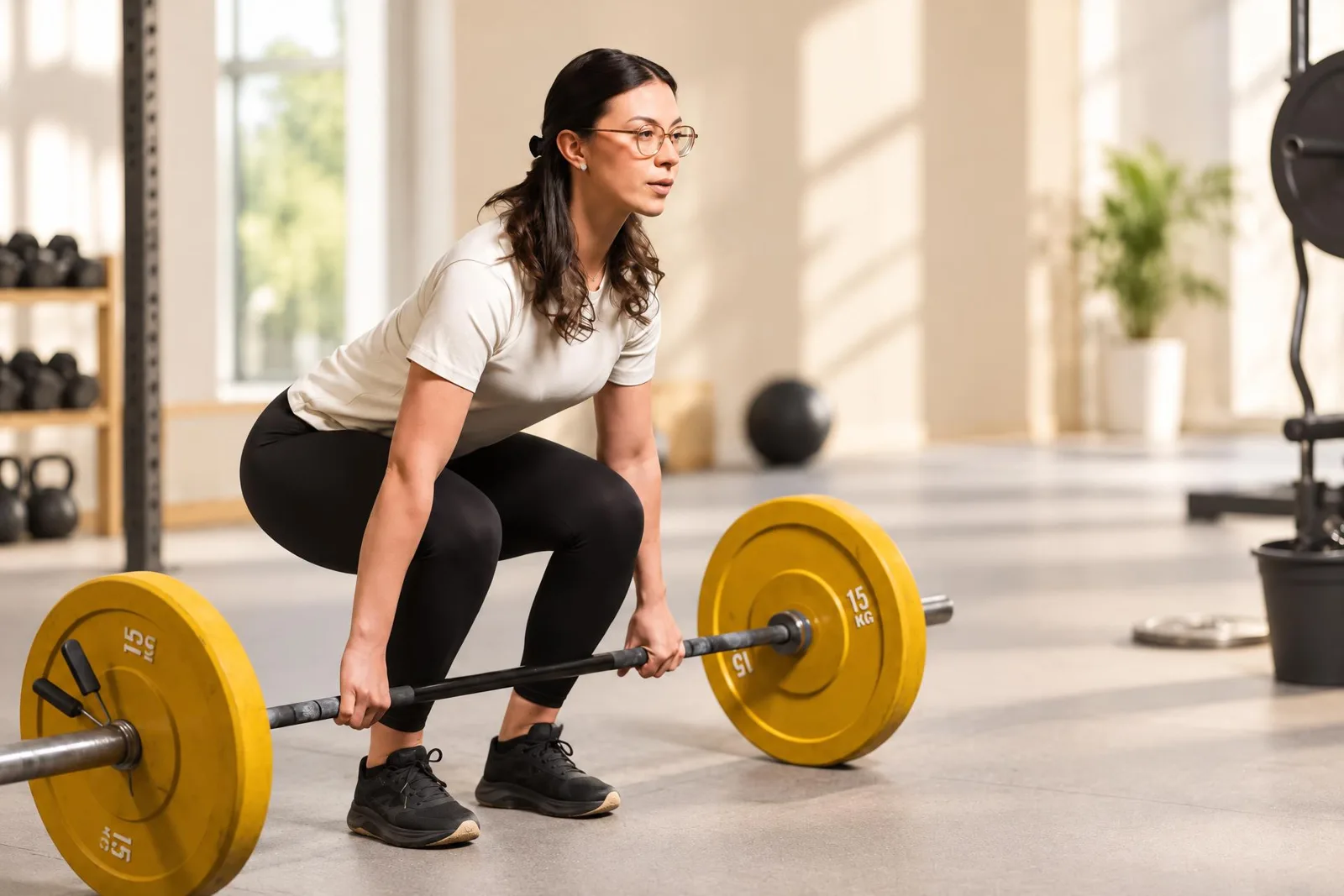
- Set up the same way every time: feet about hip-width, the weight close to your shins, hips back, a long flat back, and a deep breath braced into your belly.
- Push the floor away and stand tall, keeping the weight close to your body, then lower it under control.
- Pick a weight you can lift for 8 to 10 clean reps with 2 to 3 left in reserve, and add weight in small steps.
- Stop if you feel sharp pain, and see a physio if back pain lingers.
Deadlifts have a scary reputation. You've probably heard someone say they "wrecked their back" doing them, or watched a video of someone grinding a huge barbell off the floor with a rounded spine. So you skip them, or you do a few half-hearted reps with a light bar and hope nobody's watching.
That's a shame, because the deadlift is one of the most useful movements you can learn. It's how you safely pick things up off the floor: groceries, a suitcase, a toddler. It trains your glutes, hamstrings, back and grip in a single exercise. And done with a sensible weight and a good setup, it's not the back-breaker it's made out to be.
We pulled together what you need to start: the different deadlift variations and which one suits you, a step-by-step setup, research on deadlifts and back pain (including a study of deadlift training in people who already had back pain), how the trap bar compares with a straight barbell, the most common beginner mistakes, and how to pick your starting weight and progress. One note before you begin: if you have current back pain, are pregnant or postpartum, or have a history of injury, check with a doctor or physio first.
What does a deadlift train?
This section covers why the deadlift is worth learning, even if you never plan to lift heavy.
The deadlift is a hip hinge: you push your hips back, keep your back long, and stand up by driving your hips forward. It mainly trains:
- Glutes: they drive your hips forward at the top.
- Hamstrings: they control the hinge and help extend your hips.
- Back muscles: they hold your spine in position under load.
- Quads: especially at the start of a lift from the floor.
- Grip and upper back: holding the weight close.
In everyday life, it's the movement behind picking anything up from the ground. Practicing it with good form and gradually heavier weights is one of the simplest ways to make those everyday lifts feel easy.
How to deadlift for beginners: which variation to start with
There isn't one "real" deadlift. This block helps you pick the version that fits your body, equipment and confidence.
| Variation | What it looks like | Good for | Watch out for |
|---|---|---|---|
| Kettlebell deadlift | A kettlebell between your feet, lifted from the floor | Absolute beginners, learning the hinge, home workouts | Kettlebells top out quickly; you'll outgrow them |
| Romanian deadlift (RDL) | Start standing, lower dumbbells or a bar to mid-shin, stand back up | Hamstrings and glutes, learning to keep the weight close | Not a lift from the floor; stop where your back stays flat |
| Trap bar deadlift | Stand inside a hexagonal bar, lift with handles at your sides | Beginners in a gym, people with long legs or limited mobility | Not every gym has one |
| Conventional deadlift | Barbell on the floor, feet hip-width, hands just outside your legs | The classic strength lift once the hinge feels solid | Needs the most practice to keep the bar close and the back flat |
| Sumo deadlift | Wide stance, hands inside your legs | People who find a wide stance more comfortable | Needs good hip mobility |
Romanian deadlift vs deadlift
The main difference is where the lift starts. A conventional deadlift starts from the floor with more knee bend; an RDL starts standing and keeps the knees softer, putting more emphasis on the hamstrings stretching under load. A 2018 study in the Journal of Exercise Science & Fitness compared the two in 21 men and found higher glute activity in the conventional deadlift, along with much more quad involvement. Both are useful; many programs include one of each.
Trap bar vs straight bar
A 2011 study in the Journal of Strength and Conditioning Research by Swinton and colleagues tested 19 powerlifters with both bars. With the trap bar, lifters handled more weight (about 265 kg vs 245 kg), produced more power, and had lower forces at the lower back and hips but higher forces at the knees. For beginners, that usually means the trap bar is easier to learn and less demanding on the back, though it shifts more work to your legs. These were experienced male lifters, so the exact numbers won't match a beginner, but the pattern is consistent with why many coaches start beginners on the trap bar.
How to deadlift: step-by-step setup and form
Here's the setup for a kettlebell or barbell deadlift from the floor. The same cues apply to the trap bar.
1. Set your feet
Stand with your feet about hip-width apart, toes pointing forward or slightly out. For a barbell, the bar should sit over the middle of your feet, close enough to almost touch your shins. For a kettlebell, place it between your feet, in line with your ankles.
2. Hinge down to the weight
Push your hips back as if you're closing a car door with your butt. Let your knees bend as much as you need to reach the handle or bar, but think "hips back" first, "knees bend" second. Your shins should be close to vertical.
3. Grip and set your back
Grab the weight with your hands just outside your legs. Pull your shoulders slightly down and back, as if you're trying to bend the bar around your legs. Your back should be long and flat, from your head to your hips, not rounded and not overly arched. Look at the floor a few feet in front of you.
4. Breathe and brace
Take a big breath into your belly and tighten your core as if someone is about to poke you in the stomach. Hold that brace for the rep.
5. Push the floor away
Instead of thinking "pull with your back," think "push the floor away with your feet." Keep the weight close, sliding it up your shins and thighs. Your hips and shoulders should rise together.
6. Stand tall
Finish by squeezing your glutes and standing straight up. Don't lean back or shrug at the top; just stand tall.
7. Lower under control
Reverse the movement: hips back first, then bend your knees once the weight passes them. Keep the weight close and your back flat until it touches the floor. Reset your breath before the next rep if you need to.
Quick form checklist
- Weight stays close to your body the whole time
- Back stays long and flat
- Hips and shoulders rise together
- You finish standing tall, not leaning back
- Every rep looks the same
Filming one set from the side is the fastest way to check your form. Compare it with a video from a qualified coach.
Is deadlifting bad for your back?
This is the biggest worry for most beginners, so here's what the research actually says.
Injury rates in lifting are low
A 2024 updated systematic review in BMJ Open Sport & Exercise Medicine by Berglund and colleagues pooled 17 reports on injuries in weightlifting and powerlifting, sports built around heavy lifts like the deadlift. Injury incidence was about 1.0 to 4.4 injuries per 1,000 training hours in powerlifting, which the authors described as low. The lower back was among the most commonly injured areas, along with the shoulder. These are competitive lifters training with very heavy loads, so the picture for a beginner using moderate weights is likely even more favorable.
Deadlift training can help some people with back pain
In a 2015 study in the Journal of Strength and Conditioning Research, Berglund and colleagues had 35 adults with mechanical low back pain do 8 weeks of supervised deadlift training. Most, but not all, improved. The people most likely to benefit had lower pain and disability to begin with and better endurance in their back and hip extensor muscles. The authors advised checking that people have enough back strength and low enough pain before deadlifting.
More broadly, a 2021 systematic review and meta-analysis in Sports Medicine Open by Tataryn and colleagues (8 studies, 408 participants) found that 12 to 16 weeks of posterior-chain resistance training (exercises like deadlifts and hip lifts) reduced disability more than general exercise in people with chronic low back pain, with a borderline benefit for pain and no difference in side effects.
What this means for you
- The deadlift isn't inherently dangerous. Like any exercise, the risk comes mostly from too much weight, too soon, with poor control.
- If you have current back pain, a physio can tell you whether and how to start. Supervised, gradual deadlift training has helped many people with back pain, but not everyone.
- If you've had pelvic floor symptoms (leaking, heaviness or pressure when lifting), know that the 2024 review found pelvic floor dysfunction was very common among women in lifting sports, reported by about half of the female lifters studied. It's worth seeing a pelvic health physio, who can help you keep lifting comfortably.
Common deadlift mistakes beginners make
- Starting too heavy. The most common mistake by far. If your back rounds or the weight drifts away from your body, it's too heavy.
- Squatting the deadlift. Bending your knees too much and keeping your hips too low turns it into an awkward squat. Think "hips back."
- Letting the weight drift forward. The further the weight is from your body, the harder your back has to work. Keep it close.
- Jerking the weight off the floor. Take the slack out first: grip, tighten your arms and brace, then push the floor away smoothly.
- Leaning back at the top. Standing tall with your glutes squeezed is the finish. Hyperextending your lower back adds nothing.
- Rushing the lowering. Lower under control; don't just drop it.
- Going to failure. Deadlifts are tiring. Ending each set with a couple of good reps left keeps your form clean.
How much should you deadlift as a beginner?
There's no universal starting number. Here's how to find yours.
Step 1: Learn the movement first
Spend your first one or two sessions practicing with a light kettlebell or dumbbells, or an empty trap bar, until the setup feels natural.
Step 2: Find a working weight
Pick a weight you can lift for 8 to 10 reps with good form and about 2 to 3 reps left in the tank. If you could have done five or more extra reps, go heavier next set. If your form broke down, go lighter.
Step 3: Progress gradually
Use the same weight until you can do all your sets at the top of your rep range with clean form, then add a small amount (often 5 to 10 lb for lower-body lifts). Many beginners can add weight every week or two for the first few months. This is the same progressive overload approach that works for every other lift.
Sample beginner deadlift progression
| Weeks | Variation | Sets and reps |
|---|---|---|
| 1 to 2 | Kettlebell deadlift | 3 sets of 10 |
| 3 to 4 | Trap bar deadlift (or heavier kettlebell) | 3 sets of 8 |
| 5 to 8 | Trap bar or barbell deadlift | 3 sets of 6 to 8 |
| Ongoing | Add Romanian deadlifts on another day | 2 to 3 sets of 8 to 10 |
These numbers are common beginner coaching choices, not fixed rules.
When to see a physio or doctor
- Sharp, shooting or radiating pain during or after deadlifts, especially pain that runs down your leg
- Numbness, tingling or weakness in your legs
- Back pain that lasts more than a few days or gets worse instead of better
- Leaking, heaviness or pressure in your pelvic area when lifting
- If you're pregnant or postpartum, before starting or returning to deadlifts
Normal muscle tiredness in your glutes and hamstrings the next day is expected. Sharp pain in your spine is not.
Put it together: your week
Deadlifts fit best into a full-body routine. Here's how to connect them with your other training, food, sleep and energy.
Where deadlifts go in your week
| Day | Session |
|---|---|
| Monday | Full-body A: squat, press, row, plus kettlebell or trap bar deadlift |
| Wednesday | Rest or a walk |
| Thursday | Full-body B: Romanian deadlift, pulldown, split squat, chest press |
| Weekend | Something active you enjoy |
- Do deadlifts early in the session, when you're fresh.
- Don't deadlift heavy two days in a row. Your back and hamstrings need recovery time.
Food, sleep and energy
- Eat enough protein to recover between sessions: most women who lift do well with about 1.2 to 1.6 g per kg of body weight a day.
- On a bad night's sleep, keep the deadlifts lighter, skip any heavy attempts, and focus on clean reps. Fatigue makes form slip.
- Low energy or sore back? Swap the deadlift for a lighter hinge, like a hip bridge or a light RDL, and save the heavier work for another day.
Frequently asked questions
How do I deadlift for the first time?
Start with a light kettlebell or an empty trap bar. Stand with feet hip-width, push your hips back, keep a flat back, brace, push the floor away and stand tall. Do 2 to 3 sets of 8 to 10 reps and focus on making every rep look the same.
Is the trap bar deadlift easier for beginners?
For most people, yes. A biomechanical study found the trap bar lowered the forces on the lower back and hips compared with a straight bar, while shifting more work to the knees. It also lets you stand inside the weight, which makes the setup more natural.
Is deadlifting bad for your back?
Not when done with a sensible weight and good form. Injury rates in lifting sports are low, and supervised deadlift training has helped some people with back pain. If you have current back pain, see a physio before starting.
What's the difference between a Romanian deadlift and a regular deadlift?
A regular deadlift starts from the floor with more knee bend and uses more quads and glutes. A Romanian deadlift starts standing, keeps the knees softer, and puts more emphasis on the hamstrings. Both are useful in a beginner program.
How much should a woman deadlift as a beginner?
There's no set number. Start with a weight you can lift for 8 to 10 clean reps with 2 to 3 reps to spare, often a light kettlebell or empty trap bar. Add weight in small steps as it gets easier.
Should I deadlift if I have pelvic floor problems?
Talk to a pelvic health physio first. Pelvic floor symptoms were common among women in lifting sports in a 2024 review, and a physio can help you adjust your breathing, bracing and loading so you can keep lifting.
Conclusion
Learning how to deadlift as a beginner is less about lifting heavy and more about building a solid hinge. Start with a kettlebell or trap bar, set up the same way every rep, keep the weight close, push the floor away, and stand tall. Add weight slowly, and stop well before your form breaks down.
The research is reassuring: deadlifts have a low injury rate, and gradual deadlift training has helped some people with back pain. Get help from a physio if you're in pain or have pelvic floor symptoms, then give it a few weeks. Your everyday lifts will start to feel easier, and so will the bar.
This article is for general education and isn't medical advice.
If you want help putting this into your own week, Wellio is an AI coach that sees the whole picture: it builds your plan around your workouts, meals, sleep and energy, and guides you day by day as life changes. Tell it your goal, schedule and equipment to get a starting plan with the right deadlift variation, log your sets as you go, and get suggestions for when to add weight. Join the Wellio waitlist.
Sources
- Berglund L, Aasa B, Hellqvist J, Michaelson P, Aasa U. Which Patients With Low Back Pain Benefit From Deadlift Training? Journal of Strength and Conditioning Research, 2015.pesquisa.bvsalud.org
- Berglund L, et al. Injuries in weightlifting and powerlifting: an updated systematic review. BMJ Open Sport & Exercise Medicine, 2024.doaj.org
- Tataryn N, et al. Posterior-Chain Resistance Training Compared to General Exercise and Walking Programmes for the Treatment of Chronic Low Back Pain in the General Population: A Systematic Review and Meta-Analysis. Sports Medicine Open, 2021.research.bond.edu.au
- Swinton PA, et al. A biomechanical analysis of straight and hexagonal barbell deadlifts using submaximal loads. Journal of Strength and Conditioning Research, 2011.bisp-surf.de
- An electromyographic and kinetic comparison of conventional and Romanian deadlifts. Journal of Exercise Science & Fitness, 2018.doaj.org
- NSCA. Risk-Benefit Considerations for Deadlifting in Rehabilitating Low-Back Injuries.dxpprod.nsca.com
Make it work
for your week.