Dumbbell Workout at
Home for BeginnersA Simple 4-Week Plan
A pair of dumbbells, a corner of the living room and no real plan? Here's what to buy, the six moves to learn, and a four-week plan you can repeat at home.
 By Wellio
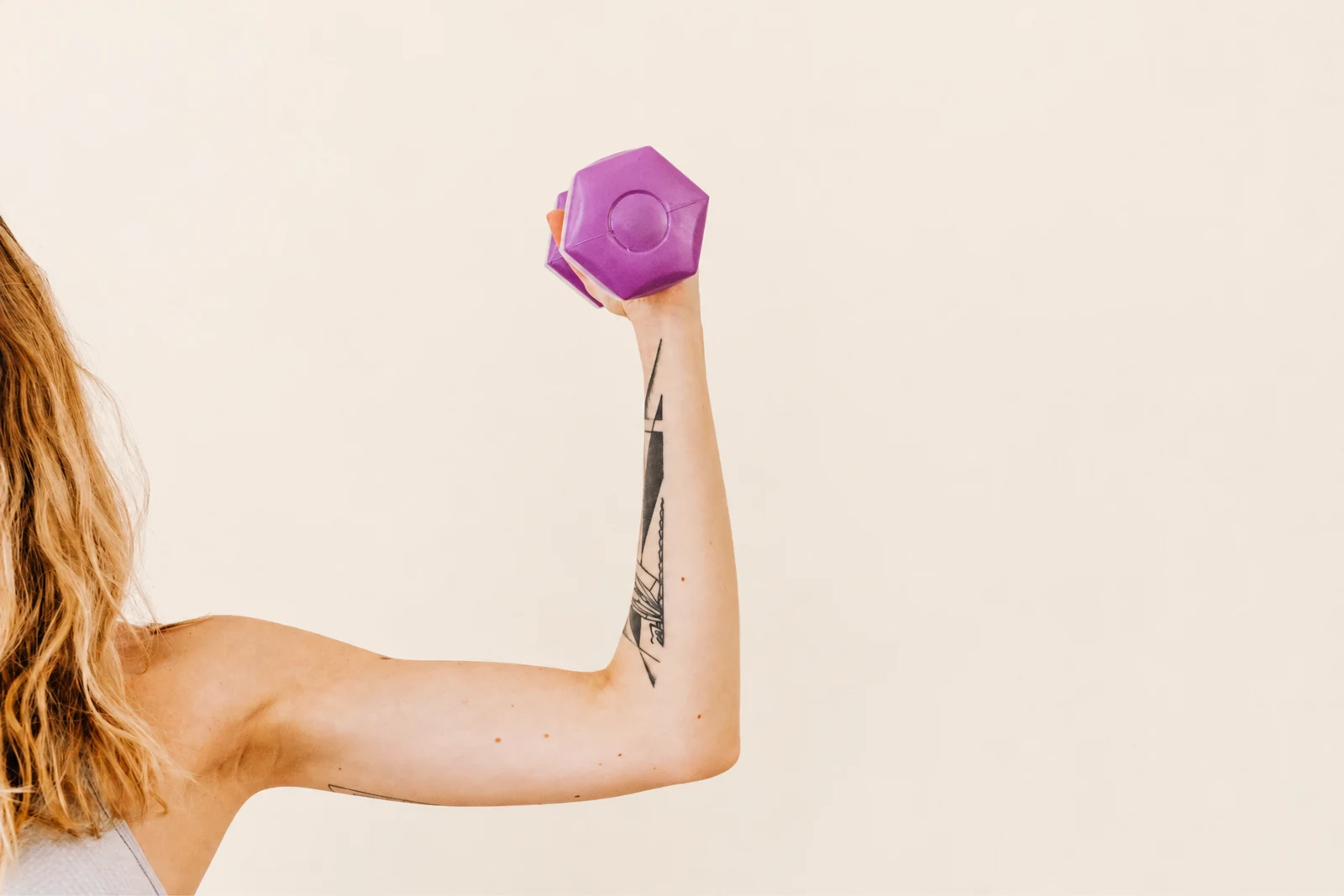
Maybe the gym feels like too much right now. Too far, too busy, too expensive, or just too intimidating. You've got a corner of the living room, a pair of dumbbells you bought in a burst of motivation, and no real plan. You do a few YouTube workouts, they're different every time, and you can't tell if any of it is working.
Training at home can absolutely work. The newest research is clear that you don't need a gym to get stronger. What you do need is a plan you repeat, a way to keep it challenging, and a few smart choices about equipment.
We built this guide around the 2026 ACSM resistance training guidelines, research on how much load you need to build muscle, and the questions people actually ask when they start lifting at home. Below you'll find what to buy, how to set up a safe space, the six movements to learn, a four-week plan, a 20-minute version for busy days, and how to keep progressing when your dumbbells start to feel light.
Can you build muscle with just dumbbells?
Yes. This section covers what the research says, because it's the first thing most people want to know.
The 2026 ACSM position stand, based on 137 systematic reviews covering more than 30,000 participants, found that home routines, resistance bands and bodyweight training produce meaningful gains in strength, muscle size and physical function. Gym access isn't required. It also found that choosing machines or free weights didn't consistently change results for average healthy adults.
Two more points from the research matter for home training:
- You don't need very heavy weights to build muscle. A 2017 meta-analysis in the Journal of Strength and Conditioning Research by Schoenfeld and colleagues (21 studies, mostly untrained people) found that lighter and heavier loads built similar amounts of muscle when sets were taken to failure. Heavier loads built more maximal strength.
- Effort is what makes lighter weights work. With light dumbbells, the last few reps of each set need to be genuinely hard.
So dumbbells are enough to get started and to keep progressing for a long time. Where home training eventually hits a limit is maximal strength on big lower-body lifts, because it's hard to own dumbbells as heavy as a loaded barbell. Most beginners have months or years of progress before that matters.
What dumbbells should you buy?
This section helps you choose without overspending. The weight ranges below are common starting points, not rules, and they depend on your strength and experience.
Adjustable vs fixed dumbbells
| Fixed dumbbells (pairs) | Adjustable dumbbells | |
|---|---|---|
| Space | Takes more room as you add pairs | One compact set |
| Cost | Cheap to start, adds up over time | Higher upfront cost |
| Speed | Grab and go | Takes a few seconds to change weight |
| Progression | Need new pairs as you get stronger | Wide range in one set |
| Best for | Starting out, or a small budget | Long-term home training |
Suggested starting weights for beginners
A practical approach is to buy two or three pairs so you have options for different exercises:
| Pair | Common range for beginner women | Used for |
|---|---|---|
| Light | 5 to 10 lb | Shoulder raises, some presses and rows to start |
| Medium | 12 to 20 lb | Presses, rows, lunges, Romanian deadlifts |
| Heavy (or one single dumbbell) | 20 to 30 lb | Goblet squats, Romanian deadlifts, carries |
Your legs and hips are usually much stronger than your arms and shoulders, so lower-body exercises need heavier weights. If you can only buy one thing, an adjustable set that goes up to at least 25 to 30 lb per hand gives you the most room to grow.
What to look for
- A secure grip that doesn't slip when your hands get sweaty.
- A shape that won't roll (hexagonal heads are a common choice).
- Weight that's easy to read so you can log what you lift.
- For adjustables, a locking system you trust, and a weight range that will still challenge you in six months.
Set up a safe home workout space
This section covers the basics so you can train without worrying about the floor, the furniture or your feet.
- Space: An area roughly the size of a yoga mat plus an arm's length on each side is enough for every exercise in this plan.
- Floor: A firm, flat surface. A mat or rubber tile helps protect floors from dropped weights and gives you grip.
- Footwear: Flat, stable shoes or bare feet on a non-slip surface. Soft running shoes can feel wobbly during squats and lunges.
- A bench alternative: A sturdy chair, step, couch edge or the floor works for step-ups, split squats and presses. Test that it won't slide before you put weight on it.
- Storage: Keep dumbbells on the floor or on a low rack, away from where kids or pets play.
The 6 dumbbell exercises to learn first
This section gives you the building blocks of the plan. Each pattern has an easier version to start with and a harder one for when you're ready.
| Pattern | Dumbbell exercise | Easier version | Harder version |
|---|---|---|---|
| Squat | Goblet squat (one dumbbell held at your chest) | Squat to a chair | Pause at the bottom, or heavier dumbbell |
| Hinge | Dumbbell Romanian deadlift | Lighter dumbbells, shorter range | Single-leg Romanian deadlift |
| Push | Dumbbell floor press | Push-ups against a counter | Push-ups from the floor, or a press on a bench |
| Pull | One-arm dumbbell row (hand on a chair) | Lighter dumbbell | Two-arm bent-over row, slower lowering |
| Single-leg | Reverse lunge or split squat | Split squat holding a support | Step-ups or Bulgarian split squats (back foot on a couch) |
| Carry or core | Farmer's carry (walk holding two dumbbells) | Shorter distance | Suitcase carry (one dumbbell, one side) or a plank with dumbbell drag |
How to learn them at home
- Watch a short video of each exercise from the side and front before your first session.
- Film your first set on your phone and compare it to the video.
- Start lighter than you think. Your first week is for learning the movement.
- Use a mirror or window reflection to check your position if you have one.
Your 4-week dumbbell workout at home for beginners
Here's a simple full-body plan built around two workouts, A and B, that you alternate. The sets and reps are common beginner coaching choices that fit the ACSM recommendation of training all major muscle groups at least twice a week.
Warm-up (5 to 8 minutes, before every session)
- 1 minute marching or easy jogging in place
- 10 bodyweight squats
- 10 hip hinges (hands on hips, push hips back)
- 10 arm circles each direction
- 1 light set of your first exercise
Workout A
| Exercise | Sets | Reps | Rest |
|---|---|---|---|
| Goblet squat | 3 | 10 to 15 | 60 to 90 seconds |
| Dumbbell floor press | 3 | 8 to 12 | 60 to 90 seconds |
| One-arm dumbbell row | 3 | 10 to 12 per side | 60 seconds |
| Dumbbell Romanian deadlift | 2 | 10 to 12 | 60 to 90 seconds |
| Farmer's carry | 2 | 30 to 40 seconds | 60 seconds |
Workout B
| Exercise | Sets | Reps | Rest |
|---|---|---|---|
| Dumbbell Romanian deadlift | 3 | 10 to 12 | 60 to 90 seconds |
| Reverse lunge | 3 | 8 to 10 per leg | 60 to 90 seconds |
| Push-ups (any version) | 3 | As many good reps as possible, up to 12 | 60 seconds |
| Two-arm bent-over row | 3 | 10 to 12 | 60 seconds |
| Plank | 2 | 20 to 40 seconds | 45 seconds |
Weekly schedule
| Week | Sessions | Focus |
|---|---|---|
| 1 | A, B (2 days) | Learn the moves, start light |
| 2 | A, B, A (3 days, or 2 if busy) | Find weights that leave 2 to 3 reps in reserve |
| 3 | B, A, B | Add a rep or two where you can |
| 4 | A, B, A | Add weight or a harder version where you hit the top of your rep range |
Leave at least one day between sessions. Each workout takes about 35 to 45 minutes including the warm-up.
How hard should it feel?
Many coaches recommend ending most sets with about 2 to 3 reps left in the tank. If you could easily do five or more extra reps, the weight or version is too easy. Because home dumbbells are often lighter, it's normal for your sets to sit in the 12 to 15 rep range and still be effective, as long as the last reps are hard.
The 20-minute busy-day version
Some weeks, 45 minutes isn't happening. This section gives you a short option so you don't lose momentum.
Do 3 rounds of this circuit with minimal rest between exercises and about 60 seconds between rounds:
| Exercise | Reps |
|---|---|
| Goblet squat | 12 |
| Dumbbell floor press or push-ups | 10 |
| One-arm row | 10 per side |
| Dumbbell Romanian deadlift | 12 |
Start with a 3-minute warm-up (marching, bodyweight squats, arm circles). That's about 20 minutes total.
Circuits like this are a good way to keep the habit going. On weeks when you have more time, go back to the full workouts, because longer rests let you lift a little heavier and track progress more clearly.
How to progress when your dumbbells feel too light
This is the most common home training problem. You've gotten stronger and your dumbbells haven't. This section gives you options before you buy more weights.
A 2015 meta-analysis in Sports Medicine by Schoenfeld and colleagues found that repetitions lasting anywhere from about half a second to 8 seconds produced similar muscle growth, while very slow reps (longer than about 10 seconds) were less effective. So slowing down is a useful tool, within reason. A small 2021 trial in PeerJ by Lacerda and colleagues found that 2-second and 6-second reps, taken to failure, built similar muscle in untrained men. The other strategies below are common coaching methods:
| Method | How to use it |
|---|---|
| Add reps | Work up to the top of your rep range, then a few more (up to about 20) |
| Slow the lowering | Take about 3 seconds to lower the weight on each rep |
| Add a pause | Hold 1 to 2 seconds at the hardest point, like the bottom of a squat |
| Go single-leg or single-arm | Split squats instead of squats, single-leg Romanian deadlifts instead of two-leg |
| Raise your back foot | Bulgarian split squats with your back foot on a couch |
| Add a set | Go from 2 to 3 or from 3 to 4 sets on that exercise |
| Shorten rest slightly | Use with care; it can lower the weight you can handle |
When you're consistently doing 15 to 20 reps with good form and a slow tempo, and it still feels easy, that's the signal to buy heavier dumbbells or upgrade to an adjustable set.
Track it
Write down the exercise, weight, reps and any change (like "3-second lowering" or "single-leg") for each session. Without notes, it's easy to keep repeating the same easy sets for months.
Common home workout mistakes to avoid
- Doing a different random workout every day. Repeating the same plan is what lets you see progress.
- Using weights that are too light for your legs. Hold a heavier dumbbell for squats and hinges, or switch to single-leg versions.
- Skipping the warm-up because you're already home and short on time.
- Never getting close to failure. With light weights, the last few reps must be hard.
- Training on a slippery floor or in soft shoes.
- Not tracking anything. A notes app is enough.
If you feel sharp pain (not normal muscle effort), stop the exercise. If pain continues, or if you're pregnant, postpartum, or managing an injury or medical condition, check with a doctor or physio before starting a new program.
Put it together: your week
Home training makes it easier to fit workouts around real life. Here's how to connect it with food, sleep and energy.
A sample week
| Day | Plan |
|---|---|
| Monday | Workout A (40 minutes) |
| Tuesday | Walk or rest |
| Wednesday | Workout B, or the 20-minute version if the day is packed |
| Thursday | Rest |
| Friday | Workout A |
| Weekend | Walk, an activity you enjoy, or rest |
Food, sleep and energy
- Protein: Muscle needs building material. The 2025 to 2030 Dietary Guidelines for Americans recommend about 1.2 to 1.6 g of protein per kg of body weight per day, which suits most women who lift. Spread it across meals.
- Timing: Training at home makes early or late sessions easy. Eat something light beforehand if it's been a long time since your last meal.
- Sleep: After a bad night, do the 20-minute version or keep your usual workout a little lighter. Save extra reps for well-rested days.
- Energy: If your energy is low for several days in a row, look at sleep and how much you're eating before cutting workouts entirely.
After four weeks, look back at your log. If your reps or weights have gone up on most exercises, the plan is working. Keep going with the same structure and keep adding small challenges.
Frequently asked questions
Is a dumbbell workout at home for beginners enough to build muscle?
Yes. The 2026 ACSM guidelines found home routines, bands and bodyweight training produce meaningful gains, and research shows lighter weights can build muscle when sets are taken close to failure. Train your whole body at least twice a week and keep making it harder over time.
What weight dumbbells should a beginner woman buy?
A common starting point is a light pair around 5 to 10 lb, a medium pair around 12 to 20 lb, and something heavier around 20 to 30 lb for squats and deadlifts. An adjustable set that goes up to at least 25 to 30 lb per hand gives you more room to progress.
Are adjustable dumbbells worth it?
For long-term home training, often yes. They save space and cover a wide range of weights, though they cost more upfront and take a few seconds to adjust. Fixed pairs are cheaper to start with if you're not sure you'll stick with it.
How many days a week should I do dumbbell workouts at home?
Two to three full-body sessions a week, with at least one rest day between them. That meets the US Physical Activity Guidelines and the ACSM recommendation of training all major muscle groups at least twice a week.
What do I do when my dumbbells get too light?
Add reps, slow down the lowering phase, add pauses, or switch to single-leg and single-arm versions. When you can do 15 to 20 controlled reps and it still feels easy, it's time for heavier dumbbells.
Can I do a full body dumbbell workout every day?
It's better to leave at least a day between full-body strength sessions so your muscles can recover. On the days in between, walking, stretching or light activity are good options.
Conclusion
A dumbbell workout at home for beginners can take you a long way. Train your whole body two or three times a week, learn six basic movements, pick weights that make the last few reps hard, and repeat the same plan long enough to see progress. When the dumbbells start feeling light, add reps, slow down, pause or go single-leg before you buy more.
You don't need a gym, a big budget or perfect motivation. You need a plan, a log and a few weeks of consistency. Start with week one and see where your numbers are after a month.
This article is for general education and isn't medical advice.
If you want help putting this into your own week, Wellio is an AI coach that sees the whole picture: it builds your plan around your workouts, meals, sleep and energy, and guides you day by day as life changes. Tell it your goal, schedule and that you're training at home with dumbbells to get a starting plan, then log your sets and get suggestions for when to add reps or weight. Join the Wellio waitlist.
Sources
- American College of Sports Medicine. 2026 resistance training position stand (press release via Newswise).newswise.com
- Centers for Disease Control and Prevention. Physical Activity Guidelines for Adults.cdc.gov
- Schoenfeld BJ, Grgic J, Ogborn D, Krieger JW. Strength and hypertrophy adaptations between low- vs. high-load resistance training: a systematic review and meta-analysis. Journal of Strength and Conditioning Research, 2017 (summary by the Canadian Kinesiology Alliance).cka.ca
- Schoenfeld BJ, Ogborn DI, Krieger JW. Effect of repetition duration during resistance training on muscle hypertrophy: a systematic review and meta-analysis. Sports Medicine, 2015 (as summarized by Muscle and Motion).muscleandmotion.com
- Lacerda LT, et al. Resistance training with different repetition duration to failure: effect on hypertrophy, strength and muscle activation. PeerJ, 2021.peerj.com
- American Academy of Family Physicians. Dietary Guidelines for 2025 to 2030: Recommendations From the USDA and HHS. American Family Physician, 2026.aafp.org
Make it work
for your week.