How to Bench Press
for BeginnersSetup, Form and the Right Variation for You
How to bench press for beginners: which variation to start with, step-by-step setup and form cues, grip width, training without a spotter and how to progress.
 By Wellio
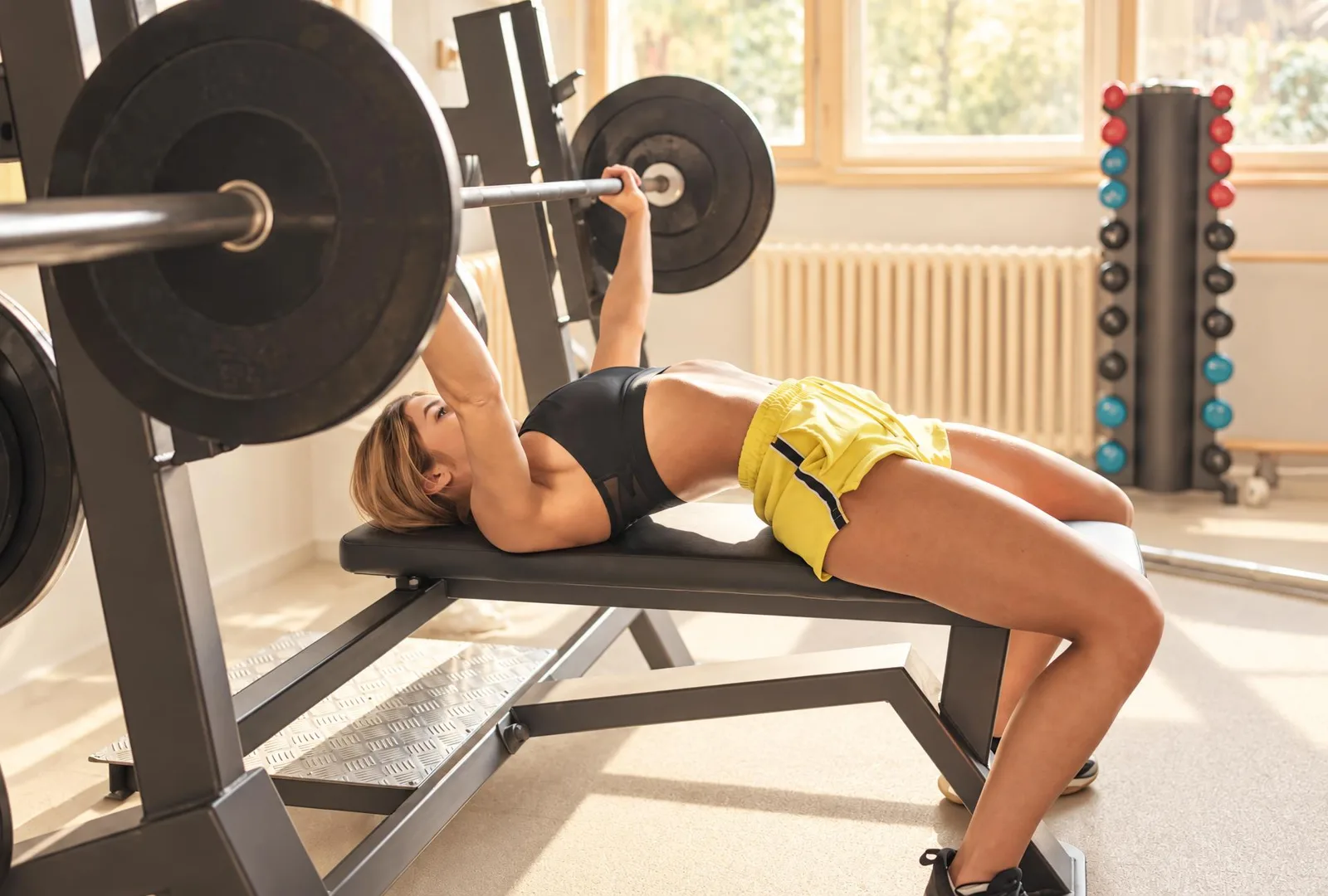
The bench press has a reputation as the "guy lift," the one with a crowd around it on Mondays. So it's easy to stick to the chest press machine forever, or skip pressing and wonder why your upper body isn't getting stronger.
The bench press doesn't have to be heavy, loud or barbell-only. A dumbbell press on a bench counts. So does a machine press. And once you know how to set up, the barbell version is a lot less intimidating than it looks.
Below: the main variations, a step-by-step setup, what research says about grip width, how to train without a spotter, common mistakes, and how to pick a starting weight and progress. One note before you begin: if you have current shoulder pain, a past shoulder injury, or are pregnant or postpartum, check with a doctor or physio first.
What does the bench press train?
The bench press is a horizontal push: you push a weight away from your chest while lying on your back. It mainly trains:
- Chest (pectoralis major): the main driver of the press.
- Front of the shoulders (anterior deltoids): they help lift the weight, especially at the bottom.
- Triceps: they straighten your elbows to finish each rep.
- Upper back and core: they keep you stable on the bench.
It's also one of the easiest upper body lifts to track and progress, which helps if your upper body strength has felt stuck.
How to bench press for beginners: which variation to start with
There are several ways to press, and the best starting point depends on your experience, your gym and how confident you feel.
| Variation | What it is | Good for | Watch out for |
|---|---|---|---|
| Chest press machine | Seated, pushing handles forward on a fixed path | First-time lifters, training alone, learning the movement | Seat height changes everything; set handles at mid-chest |
| Dumbbell bench press | Lying on a flat bench, pressing two dumbbells | Most beginners; each arm works independently; easy to bail safely | Getting heavy dumbbells into position takes practice |
| Incline dumbbell press | Same, on a bench set to about 30 to 45 degrees | People whose shoulders don't love flat pressing | Too steep an incline turns it into a shoulder press |
| Smith machine bench press | Barbell fixed on rails, with built-in safety hooks | A step toward the barbell; training without a spotter | Fixed bar path; set safeties before you start |
| Barbell bench press | The classic, free barbell on a flat bench | Once you're comfortable with dumbbells; easy to load in small jumps | Needs a spotter or safety arms as weights get heavier |
Where most beginners should start
For most beginners, we suggest a chest press machine or dumbbell bench press. Once you can press dumbbells with good control for a few weeks, add the barbell.
Do dumbbells and machines work as well as a barbell?
For building strength and muscle in general, yes. A 2023 systematic review in BMC Sports Science, Medicine and Rehabilitation by Haugen and colleagues compared machine-based and free-weight training across 13 studies and over 1,000 adults. It found no clear difference in strength or muscle gains between the two in direct comparisons. Strength gains did tend to be specific to the mode you trained: if you train on a machine, you'll get best at the machine. So if your goal is a stronger barbell bench, you'll eventually want to practice with the barbell.
How to bench press: step-by-step setup and form
These steps are written for the barbell bench press. For dumbbells, the setup is almost identical; we note the differences as we go.
1. Set your position on the bench
Lie on the bench with your eyes roughly under the bar. Your head, upper back and glutes should stay in contact with the bench throughout the lift.
Dumbbells: sit on the end of the bench with the dumbbells resting on your thighs. Lie back and use your knees to help "kick" them up to your chest as you go.
2. Plant your feet
Put your feet flat on the floor, roughly under or slightly behind your knees. Push them gently into the floor. This gives you a stable base. If your feet don't reach the floor comfortably, put a plate or step under them.
3. Set your shoulder blades
Pull your shoulder blades back and down, as if you're tucking them into your back pockets. This gives you a stable platform to press from and keeps your shoulders in a more comfortable position. You'll have a small, natural arch in your lower back. That's normal. You don't need an exaggerated arch.
4. Grip the bar
Grip the bar a little wider than shoulder width, so your forearms are roughly vertical when the bar touches your chest. Wrap your thumbs around the bar (never use a "thumbless" grip). Keep your wrists stacked over your elbows, not bent back.
5. Unrack and position the bar
Take a breath, lift the bar out of the rack with straight arms, and move it over your shoulders. Pause there for a second before your first rep.
Dumbbells: start with the dumbbells over your chest, arms straight, palms facing your feet or slightly turned in.
6. Lower with control
Take a breath and lower the bar under control to your lower chest, around nipple level or slightly below. Your elbows should come down at roughly 45 to 70 degrees from your body, not flared straight out to the sides. Aim for about 2 to 3 seconds on the way down.
7. Press up
Push the bar up and slightly back toward your shoulders, keeping your shoulder blades pinned and your feet planted. Breathe out as you finish the press. Pause at the top, then start the next rep. After your last rep, move the bar back until it touches the uprights, then lower it into the hooks.
What's the best grip width for bench press?
Here's what the research on grip width shows.
A 2021 study in the International Journal of Environmental Research and Public Health by Saeterbakken and colleagues tested narrow, medium and wide grips in 28 men, both novices and experienced lifters. Both groups could lift about 7% to 8% less with a narrow grip than with a medium or wide grip, while medium and wide grips produced similar loads. Chest muscle activity was similar across all three grips. The main differences were in the arms: a wide grip used the triceps a bit less, and biceps activity rose as grip width increased.
A 2023 study in Sports by Tanimoto and colleagues compared wide and narrow grips in 14 men. Both groups pushed slightly outward on the bar with a wide grip and slightly inward with a narrow grip, and the balance of chest and triceps activity barely changed with grip width.
Both studies included only men, and muscle activity (EMG) doesn't directly predict muscle growth, but the takeaway is reassuring.
How to bench press without a spotter
Many beginners train alone and worry about getting stuck under the bar. Here's how to stay safe. These are common gym safety practices rather than research findings.
- Use dumbbells or a machine until you're comfortable. With dumbbells, you can simply lower them to the floor if a rep fails.
- Use a rack with safety arms (also called safety pins or spotter arms). Set them just below the height of your chest when you're lying on the bench with your back set, so the bar rests on them instead of on you if you can't finish a rep.
- Use a Smith machine with its built-in safety hooks, if your gym has one.
- Leave reps in the tank. If you stop each set with 2 to 3 reps left, you're very unlikely to fail a rep.
- Ask for a spot. "Could you spot me for one set? Just help if it stalls" is enough.
Is the bench press bad for your shoulders?
Here's what the evidence suggests.
Lifting in general has a low injury rate. A 2024 systematic review in BMJ Open Sport & Exercise Medicine by Tung and colleagues found powerlifting injury rates of about 1.0 to 4.4 injuries per 1,000 hours of training, with the lower back, shoulder and elbow among the most common sites. That's in competitive lifters training near their maximum, not beginners lifting moderate weights. The same review found pelvic floor symptoms such as leaking urine were very common in female lifters (50% compared with 9.3% of males), which is worth knowing if you notice it during heavy lifts.
A 2026 article in the NSCA's Personal Training Quarterly also notes that resistance training is among the safest forms of activity in general fitness settings, and that close supervision and good coaching reduce risk further when you're learning a new lift.
For beginners, most shoulder discomfort when pressing comes from setup: elbows flared out wide, shoulder blades not set, bouncing the bar off the chest, or simply going too heavy too soon. The fixes are in the next section.
Common bench press mistakes beginners make
| Mistake | Why it's a problem | The fix |
|---|---|---|
| Elbows flared straight out to the sides | Puts more stress on the front of the shoulder | Angle elbows about 45 to 70 degrees from your body |
| Shoulder blades not set | Less stable, more shoulder strain | Pull them back and down before every set |
| Bouncing the bar off your chest | Less control, more risk | Lower in 2 to 3 seconds, brief pause or touch |
| Butt lifting off the bench | Changes the lift and stresses the lower back | Keep glutes on the bench throughout |
| Wrists bent back | Wrist discomfort, weaker press | Bar in the heel of your palm, wrist over elbow |
| Going too heavy too soon | Form breaks down, higher chance of a failed rep | Start light and progress in small steps |
How much should a beginner bench press?
There's no "right" number. Your starting weight depends on your size, experience and the variation you choose. What matters is finding a weight that challenges you with good form, then building from there.
Step 1: Learn the movement first
Start very light. For the barbell, that may be the empty bar: a standard Olympic barbell weighs 45 lb (20 kg), and many gyms also have a lighter 35 lb (15 kg) bar or fixed-weight barbells. For dumbbells, start with a pair you can press 12 to 15 times easily.
Step 2: Find a working weight
Increase the weight until you can do 8 to 12 clean reps with 2 to 3 reps left in reserve. That's your working weight. If you're not sure how hard you're working, our guide on how to know if you're lifting heavy enough walks through the signs.
Step 3: Progress gradually
When you can do the top of your rep range on all sets with good form, add a little weight. Typical jumps are 2.5 to 5 lb for the barbell (adding 1.25 to 2.5 lb per side) or the next dumbbell up. If the jump is too big, add a rep or two first. Our progressive overload guide explains this "double progression" method in more detail.
Sample beginner bench press progression
This is a common coaching approach, not a research protocol.
| Weeks | Variation | Sets x reps | Notes |
|---|---|---|---|
| 1 to 2 | Chest press machine or dumbbell bench press | 3 x 10 to 12 | Learn the setup, leave 3 reps in reserve |
| 3 to 4 | Dumbbell bench press | 3 x 8 to 12 | Add weight when you hit 12 on all sets |
| 5 to 6 | Dumbbell bench or barbell bench (light) | 3 x 8 to 10 | Practice barbell setup with safety arms |
| 7 to 8 | Barbell bench press | 3 x 6 to 10 | Small, steady jumps; keep 2 to 3 reps in reserve |
When to see a physio or doctor
Some aches are normal when you start pressing. Others need attention. See a physio or doctor if you have:
- Sharp or pinching pain in the front or top of your shoulder during or after pressing
- Pain that lingers more than a few days or keeps coming back every session
- Clicking or catching with pain, or a feeling your shoulder isn't stable
- Numbness, tingling or weakness in your arm or hand
- Chest pain, faintness or shortness of breath during exercise (stop and seek medical help right away)
- Leaking urine or pelvic pressure during heavy lifts (a pelvic health physio can help)
If you're pregnant or postpartum, talk to your doctor or a pelvic health physio about pressing, especially lying flat on your back later in pregnancy.
Put it together: your week
Here's how pressing fits a real week.
Where bench press goes in your week
- Two full-body days a week: press on both days. For example, dumbbell bench press on Monday, incline dumbbell press on Thursday.
- Upper/lower split: put a bench press variation at the start of each upper body day, when you're freshest. Our upper body workout for women at the gym has two full upper body sessions that pair pressing with pulling.
- Balance it out: for every set of pressing, do roughly a set of pulling (rows, lat pulldowns). It's a common coaching rule that helps keep your shoulders happy.
Food, sleep and energy
- Protein: pressing builds muscle best with enough protein. Most women who lift do well with about 1.2 to 1.6 g per kg of body weight a day, spread across meals.
- Sleep: after a short night, keep your press but skip heavy attempts and leave a few more reps in the tank.
Frequently asked questions
How do I bench press for the first time?
Start with a chest press machine or a light pair of dumbbells on a flat bench. Plant your feet, pull your shoulder blades back and down, lower the weight to your lower chest with your elbows angled in, and press back up with control. Do 3 sets of 10 to 12 reps, leaving a few reps in reserve.
Is the dumbbell bench press better for beginners?
For most beginners, yes. Dumbbells let each arm work on its own, fit different body shapes, and are easier to bail out of safely if you can't finish a rep. Research comparing machines and free weights found similar strength and muscle gains overall.
What is a good bench press for a beginner woman?
There's no standard number. Many women start with dumbbells between 10 and 25 lb each or the empty barbell, but it depends on your size and experience. The best measure is progress: if you're adding weight or reps over time with good form, you're doing well.
Can I bench press without a spotter?
Yes, if you set up safely. Use dumbbells, a machine, a Smith machine, or a rack with safety arms set just below chest height. Leave 2 to 3 reps in reserve on every set so you're unlikely to fail a rep.
Conclusion
Learning how to bench press as a beginner is simpler than the crowded bench on a Monday makes it look. Start with a machine or dumbbells, set up the same way every time, lower with control to your lower chest with your elbows angled in, and press with a medium grip. Train safely with dumbbells, a machine or safety arms, and leave a few reps in reserve.
Then build slowly: a rep, then a little weight, week by week. Balance pressing with pulling, eat enough protein, and ease off when sleep or energy is low.
This article is for general education and isn't medical advice.
If you want help putting this into your own week, Wellio is an AI coach that sees the whole picture: it builds your plan around your workouts, meals, sleep and energy, and guides you day by day as life changes. Answer a few questions about your goal, schedule and equipment to get a starting plan with the right press for you, log your sets as you go, and get suggestions for when to add weight. Join the Wellio waitlist.
Sources
- Saeterbakken AH, Stien N, Pedersen H, Solstad TEJ, Cumming KT, Andersen V. The Effect of Grip Width on Muscle Strength and Electromyographic Activity in Bench Press among Novice- and Resistance-Trained Men. International Journal of Environmental Research and Public Health, 2021pmc.ncbi.nlm.nih.gov
- Tanimoto M, Arakawa H, Sato M, Nagano A. Lateral Force and EMG Activity in Wide- and Narrow-Grip Bench Press in Various Conditions. Sports, 2023doaj.org
- Haugen ME, et al. Effect of free-weight vs. machine-based strength training on maximal strength, hypertrophy and jump performance: a systematic review and meta-analysis. BMC Sports Science, Medicine and Rehabilitation, 2023doaj.org
- Tung MJ, Lantz GA, Lopes AD, Berglund L. Injuries in weightlifting and powerlifting: an updated systematic review. BMJ Open Sport & Exercise Medicine, 2024epistemonikos.org
- Tumminello N. The Safest and Riskiest Forms of Resistance Training. NSCA Personal Training Quarterly 13.1nsca.com
- American Academy of Family Physicians. Dietary Guidelines for 2025 to 2030. American Family Physician, 2026aafp.org
Make it work
for your week.