How to Know If You're
Lifting Heavy EnoughA Self-Check Guide
Most people lift lighter than they think. The signs your weights are too light, a simple rep test to check this week, and when lighter weights are completely fine.
 By Wellio
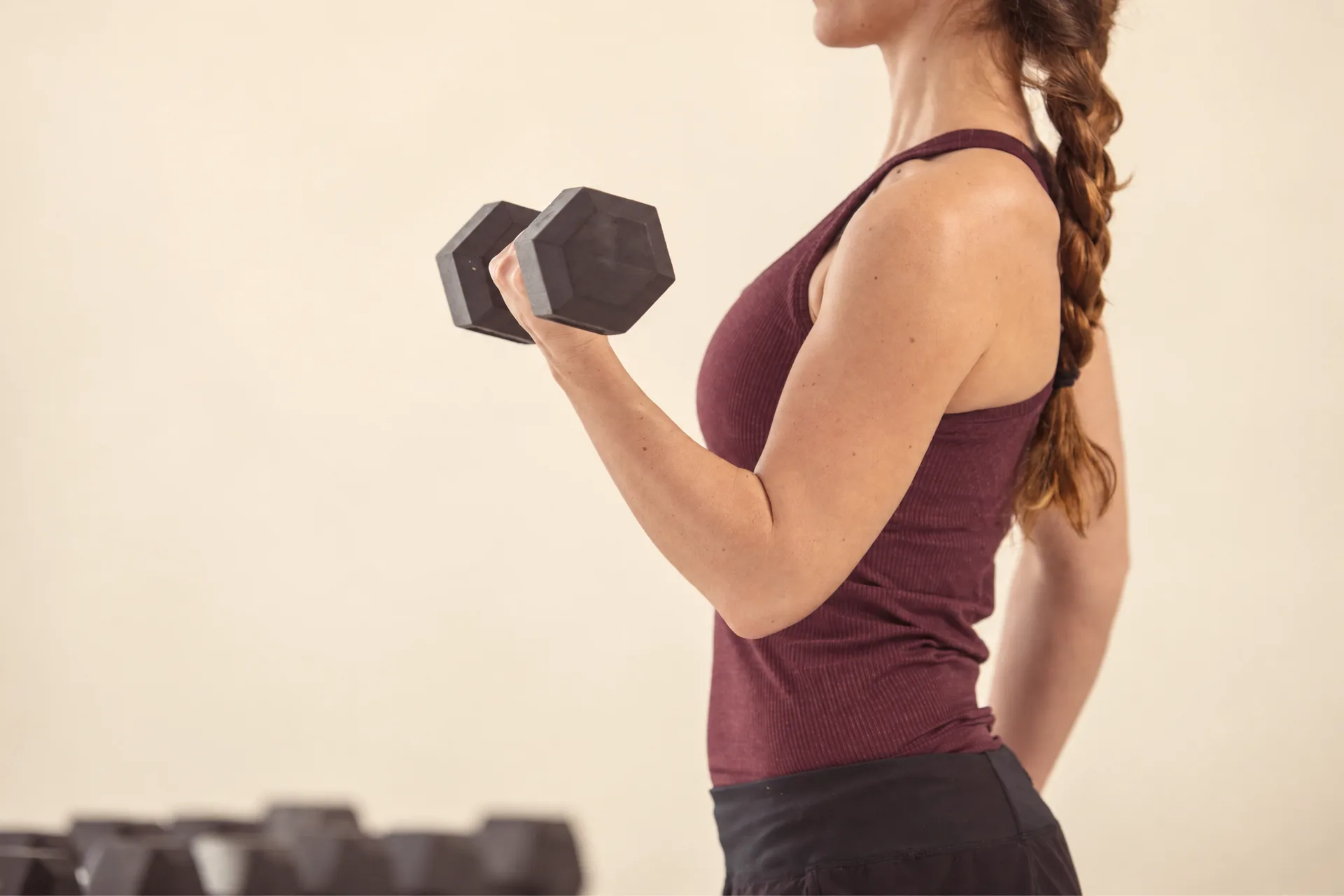
You show up. You do every set. You even sweat. But your body looks the same as it did three months ago, and the weights you grab are the same ones you grabbed in January. Somewhere in the back of your mind is the question: am I actually lifting heavy enough, or am I just going through the motions?
It's one of the most common reasons women stop seeing results, and it's hard to spot from the inside. The weight feels challenging. You're breathing hard. It doesn't feel easy. So how would you know?
The research here is surprisingly clear on two points. First, people who choose their own weights tend to choose too light, including women who already train. Second, we're not very good at judging how many reps we have left, especially on light, high-rep sets. Below we cover what "heavy enough" actually means, what the studies show, a checklist of signs your weights are too light, a simple test you can do this week, and when lighter weights are completely fine.
What "heavy enough" actually means
This block clears up the most common misunderstanding: "heavy" doesn't mean a specific number on the dumbbell.
For building muscle, what matters most is how hard the set is relative to what you can do, not the absolute weight. The 2026 American College of Sports Medicine (ACSM) position stand reports that a wide range of loads can build muscle as long as sets are challenging. A 2017 meta-analysis by Schoenfeld and colleagues found lighter and heavier weights built similar amounts of muscle when sets were taken to failure, while heavier weights built more maximal strength.
So "heavy enough" really means: the set ends close to the point where you couldn't do another good rep. A 10 lb dumbbell can be heavy enough for one exercise and far too light for another.
Coaches describe this with reps in reserve (RIR): how many more good reps you could have done when you stopped. Zero RIR means you couldn't do another. Three RIR means you stopped with three left.
How hard do sets need to be? What the research says
This block covers the evidence on proximity to failure, without repeating the full progression method from our progressive overload guide.
For muscle growth: closer matters
A 2024 meta-regression in Sports Medicine by Robinson and colleagues, drawing on 55 studies, found that muscle growth increased as sets were taken closer to failure. For strength, the relationship was negligible: stopping further from failure produced similar strength gains, as long as loads were heavy. The authors note the analysis was exploratory, because reps in reserve had to be estimated from how each study described its training. In a university news release, the researchers suggested roughly 0 to 5 reps short of failure for muscle growth, and 3 to 5 reps short with heavier loads for strength.
But you don't need to go all the way to failure
A 2023 meta-analysis in Sports Medicine by Refalo and colleagues, covering 15 studies, found no clear advantage of training to momentary muscular failure over stopping just short. The relationship between effort and muscle growth may not be a straight line: getting close seems to matter, but the very last grinding rep doesn't seem to add much.
What this means for you
Most of your working sets should end somewhere around 1 to 3 good reps from failure. That's close enough to drive growth without the fatigue and form breakdown of grinding every set to the limit. The specific 1 to 3 target is a common coaching choice that fits the research above, not a tested rule.
Why most people lift too light (and don't realize it)
This block covers the research that explains why "it feels hard" isn't enough to go on.
People pick weights that are too light
Several studies have asked people to choose their own training weights, then measured what percentage of their maximum those weights were:
| Study | Who | Weights they chose |
|---|---|---|
| Glass & Stanton, 2004, Journal of Strength and Conditioning Research | 30 untrained young adults (13 men, 17 women) | 42% to 57% of their one-rep max, all under 60% |
| Ratamess and colleagues, 2008, Journal of Strength and Conditioning Research | 46 women who already did resistance training | About 42% of max when training alone, about 51% with a personal trainer |
In the 2004 study, men and women chose similarly, and the authors concluded the self-selected loads weren't enough to drive muscle growth on their own. In the 2008 study, the women who trained with a personal trainer chose heavier weights and were also stronger, though the study couldn't prove the trainer caused the difference.
For context, a weight at around 40% to 50% of your max is one you can usually lift many more than 10 times. If you choose it for a set of 10 and stop there, you're likely stopping far from failure.
We misjudge how many reps we have left
A 2022 meta-analysis in Sports Medicine by Halperin and colleagues pooled 12 studies with 414 participants who estimated how many reps they had left before going to failure. On average, people underestimated by about one rep, meaning they actually had more left than they thought. The error varied a lot between people.
Two details matter for you:
- Estimates were much less accurate when more than about 12 reps were left. Long, light sets are exactly where your sense of effort is least reliable.
- Training experience didn't make people meaningfully more accurate. Even experienced lifters misjudged.
That's why a set of 20 with light dumbbells can feel brutal (burning muscles, heavy breathing) while still being far from your actual limit.
How to know if you're lifting heavy enough: signs your weights are too light
Run through this list honestly. Two or three yeses usually means it's time to go heavier.
- You could do 5 or more extra reps at the end of most sets.
- You've used the same weights for more than a month without adding reps or load.
- You stop at a rep number, not at an effort level. You do 10 because the plan says 10, even when 15 would be possible.
- The last rep looks and feels like the first rep. A hard set slows down near the end.
- You never feel the need to rest between sets. You could go straight into the next one.
- You can chat comfortably during the set.
- You haven't had a set in weeks that genuinely made you wonder if you'd finish it.
- Your sets regularly go past 20 reps without a clear reason, which is where effort is hardest to judge.
One thing that is not on this list: soreness. Being sore or not sore the next day is a poor guide to whether a workout was effective. We cover that in our article on soreness.
The rep test: how to check your weights this week
This is a simple way to recalibrate. It's a common coaching method, not a research protocol, and it works best on stable exercises.
Step 1: Pick a safe exercise
Choose a machine or a stable exercise where reaching failure is safe: leg press, machine chest press, lat pulldown, seated cable row, dumbbell curl, or a goblet squat with a light-to-moderate dumbbell. Don't test to failure on heavy barbell squats, deadlifts or bench press without a spotter or safety bars.
Step 2: Do one set to failure
After your warm-up, use your usual working weight. Do as many good reps as you can, stopping when your form would break down or the weight barely moves.
Step 3: Compare with your normal sets
| If you normally do... | And the test set reached... | What it means |
|---|---|---|
| 10 reps | 12 to 13 reps | You're already close (about 2 to 3 reps in reserve). Keep this weight |
| 10 reps | 15 to 18 reps | Too light. Increase the weight next session |
| 10 reps | 20+ reps | Much too light. Increase noticeably and retest in a week or two |
| 10 reps | Fewer than 10 | Too heavy for 10. Lower slightly or aim for fewer reps |
Step 4: Adjust and repeat occasionally
Use what you learned to set your weights, then repeat the test every few weeks on one or two exercises. Over time, your sense of "2 reps left" gets better because you've checked it against reality.
Group classes and light dumbbells: are they enough?
Many women come to lifting from classes, and this is often where the "too light" pattern starts.
Classes usually give everyone the same light dumbbells and high reps, so the whole room can keep up. That's great for fitness and fun, but it creates two problems for building strength:
- The weight is chosen for the group, not for you. For many exercises, it's far below your limit, especially for legs and glutes.
- Sets are long and timed. As the 2022 meta-analysis showed, effort is hardest to judge when there are many reps left, so the burn can mask how far you are from failure.
Classes can still contribute, especially when the burn genuinely brings you close to your limit. But if building strength or muscle is your goal, you'll usually need some sessions where you choose heavier weights and fewer reps. If you're making that switch, our guide to starting lifting at the gym walks through it.
When lighter weights are completely fine
Going heavier isn't always the answer. Lighter weights still work when:
- You take the set close to failure. If 25 reps with a light dumbbell genuinely leaves you with 1 to 2 reps in reserve, it can build muscle. Just know that judging this is harder on long sets.
- You're learning a new movement. Start light to learn the pattern, then increase.
- You're training at home with limited weights. Slower reps, pauses and single-leg or single-arm versions make light weights harder.
- You're returning from a break, recovering from illness or working around an achy joint. A lighter, controlled set beats skipping the session.
- You had a bad night's sleep or very low energy. Ease off for a day and come back stronger.
If something hurts (sharp pain, not normal muscle effort), stop that exercise. If pain continues, or if you're pregnant, postpartum, or managing an injury or medical condition, check with a doctor or physio before pushing harder.
Put it together: your week
Here's how to use this in a normal training week, alongside food, sleep and energy.
- Pick one session for the rep test. Test one upper-body and one lower-body exercise. Adjust your weights for the rest of the week based on the results.
- Use a simple rule for every set. Ask yourself after the last rep: could I have done 1 to 3 more good reps? If the honest answer is 5 or more, go up next set or next session.
- Write down weights and reps. Seeing the same number for weeks is the clearest sign you've stalled.
- Adjust for your real day. Slept badly or feeling run down? Keep the same weights and stop a little further from failure. Feeling great? That's the day to push for an extra rep or a heavier set.
- Eat enough to train hard. Heavier, harder sets need fuel and protein. If you're always exhausted mid-workout, look at food and sleep before blaming your effort.
After three or four weeks of honest sets, check your log. Most women who were lifting too light see their numbers start moving again quickly.
Frequently asked questions
How do I know if I'm lifting heavy enough?
Check how many good reps you have left at the end of a set. If it's usually 5 or more, the weight is too light. A simple check is to do one safe set to failure on a machine or stable exercise and compare it with your normal rep count.
Am I lifting too light if it still feels hard?
Possibly. A 2022 meta-analysis found people tend to underestimate how many reps they have left, and estimates were much less accurate on long sets with many reps remaining. Burning muscles and heavy breathing don't always mean you're close to your limit.
How heavy should I lift to build muscle?
Heavy enough that most sets end with about 1 to 3 good reps left. Research shows a wide range of weights can build muscle if sets are taken close to failure, so the right weight depends on the exercise and your rep range.
Do I need to train to failure?
No. A 2023 meta-analysis found no clear advantage of training to momentary failure over stopping just short. Getting close matters for muscle growth, but you don't need to grind out every last rep.
Why do I keep choosing weights that are too light?
It's very common. Studies of self-selected weights found both new lifters and women who already trained tended to choose weights around 40% to 57% of their maximum, well below what drives most progress. Testing a set to failure occasionally helps you recalibrate.
Is it bad to lift light weights for high reps?
Not if you take the sets close to failure. Light, high-rep sets can build muscle, but it's harder to judge your effort on them, so many people stop too early. Mixing in some heavier sets in lower rep ranges makes it easier to train hard enough.
Conclusion
So, how do you know if you're lifting heavy enough? Not by the number on the dumbbell, and not by how sweaty you get. You know by how close each set gets to your limit. Research shows most people choose weights that are too light and misjudge their effort, especially on long, light sets, so it's worth checking rather than trusting how it feels.
Do one safe test set, adjust your weights, aim to finish most sets with 1 to 3 good reps left, and write your numbers down. Keep the classes you enjoy, but give yourself some sessions with weights that genuinely challenge you. That's often the change that gets "same weights for months" moving again.
This article is for general education and isn't medical advice.
If you want help putting this into your own week, Wellio is an AI coach that sees the whole picture: it builds your plan around your workouts, meals, sleep and energy, and guides you day by day as life changes. Log your sets, reps and weights as you train, and get suggestions for when it's time to go heavier. Join the Wellio waitlist.
Sources
- Robinson ZP, Pelland JC, Remmert JF, Refalo MC, Jukic I, Steele J, Zourdos MC. Exploring the Dose-Response Relationship Between Estimated Resistance Training Proximity to Failure, Strength Gain, and Muscle Hypertrophy: A Series of Meta-Regressions. Sports Medicine, 2024.rke.abertay.ac.uk
- EurekAlert news release on Robinson et al. 2024.eurekalert.org
- Refalo MC, Helms ER, Trexler ET, Hamilton DL, Fyfe JJ. Influence of Resistance Training Proximity-to-Failure on Skeletal Muscle Hypertrophy: A Systematic Review with Meta-analysis. Sports Medicine, 2023.openrepository.aut.ac.nz
- Halperin I, et al. Accuracy in Predicting Repetitions to Task Failure in Resistance Exercise: A Scoping Review and Exploratory Meta-analysis. Sports Medicine, 2022.pesquisa.bvsalud.org
- Glass SC, Stanton DR. Self-selected resistance training intensity in novice weightlifters. Journal of Strength and Conditioning Research, 2004.lida.sport-iat.de
- Ratamess NA, Faigenbaum AD, Hoffman JR, Kang J. Self-selected resistance training intensity in healthy women: the influence of a personal trainer. Journal of Strength and Conditioning Research, 2008.bisp-surf.de
- American College of Sports Medicine. 2026 resistance training position stand (press release via Newswise).newswise.com
- Schoenfeld BJ, et al. Strength and hypertrophy adaptations between low- vs. high-load resistance training. Journal of Strength and Conditioning Research, 2017 (Canadian Kinesiology Alliance summary).cka.ca
Make it work
for your week.