Resistance Bands
vs DumbbellsWhich Should You Train With?
Resistance bands vs dumbbells: what research says about strength gains, how each feels, cost, space and progress, plus a band workout and a combined plan.
 By Wellio
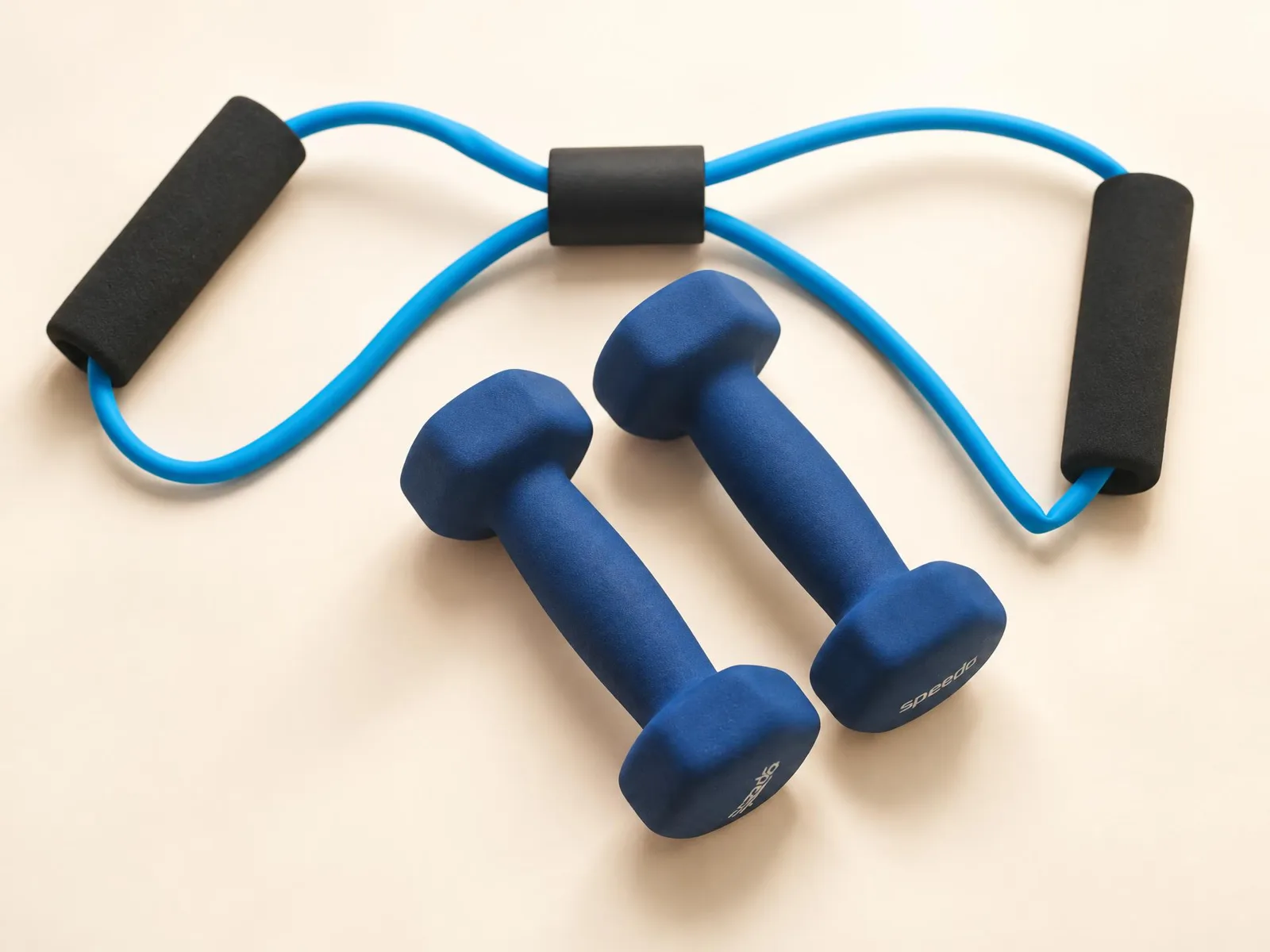
You want to train at home, or at least some of the time, and you're standing in front of two options. A bag of colorful bands for the price of one lunch out. Or a pair of dumbbells that costs more, takes up space and weighs a ton to ship.
We looked at the research on elastic versus conventional resistance training, newer reviews on band training, and the 2026 resistance training guidelines from the American College of Sports Medicine (ACSM). Below we cover what each does well, a side-by-side comparison, how to choose and combine them, a band workout, what to buy and how to stay safe.
Can you build muscle with resistance bands? What the research says
Strength: similar results
A 2019 systematic review and meta-analysis in SAGE Open Medicine by Lopes and colleagues compared training with elastic devices (tubes and flat bands) against conventional equipment (weight machines and dumbbells). Across eight studies, neither method was superior for upper body or lower body strength. The authors concluded that elastic resistance produces strength gains similar to conventional resistance training across different populations and training protocols.
An earlier randomized trial makes the same point in a group close to our readers. In a 2008 study in the Journal of Strength and Conditioning Research, Colado and Triplett assigned 45 sedentary middle-aged women to train twice a week for 10 weeks with elastic bands, weight machines or no training. Both training groups gained fat-free mass, lost fat mass and improved on push-up and squat tests, with similar benefits. The control group didn't change. It was a short study in beginners, so it shows that bands work early on, not that they match weights over years.
What newer reviews add
Recent reviews mostly look at older adults. A 2024 meta-analysis in Experimental Gerontology (9 trials, 477 participants) found band training improved chair-stand, flexibility and walking-speed tests in healthy older people, though the authors rated the certainty of evidence as very low. A 2025 meta-analysis in Frontiers in Sports and Active Living (25 trials, 1,318 older adults) found band training improved leg strength and balance compared with no training. These reviews compare bands with doing nothing, not with dumbbells, so they tell us bands work rather than that they're equal.
What the guidelines say
The 2026 ACSM position stand on resistance training, based on 137 systematic reviews, notes that bands and bodyweight work produce meaningful gains, and that a wide range of loads builds muscle as long as sets are genuinely hard. That matches earlier research: a 2017 meta-analysis by Schoenfeld and colleagues found lighter and heavier loads built similar muscle when sets were taken to failure, while heavier loads built more maximal strength.
How bands and dumbbells actually feel different
The resistance curve
A dumbbell weighs the same at every point of a lift. A band works differently: the more you stretch it, the more it resists. So a band squat is easiest at the bottom and hardest at the top, while a dumbbell squat is hardest near the bottom.
That has two effects:
- Bands are gentle at the start of a movement, which many people find easier on joints.
- The hardest part of the lift is at the end, so the muscle gets less challenge in the stretched position, where heavier dumbbell work tends to feel hardest.
Measuring progress
This is the biggest real difference. With dumbbells, you know you lifted 15 lb for 10 reps last week and 15 lb for 12 reps this week. With bands, the resistance depends on how far you stand from the anchor, how you grip, the band's age and even its brand. Labels like "medium" or "heavy" aren't standardized across brands, and the pounds printed on a band usually describe the resistance at a particular stretch, not throughout the movement.
You can still track band progress. It just takes a bit more care (see the workout section below).
Exercises each does best
- Bands shine for: pulling movements at home (rows, pulldowns, face pulls), hip and glute work (side steps, kickbacks, hip abduction), and shoulder work like pull-aparts.
- Dumbbells shine for: squats, lunges, Romanian deadlifts, presses and carries, where you want a steady, measurable load.
Resistance bands vs dumbbells: side-by-side comparison
Here's how the two compare on the things that usually decide it.
| Resistance bands | Dumbbells | |
|---|---|---|
| Cost to start | Low. A full set often costs about the same as one pair of light dumbbells | Higher, especially adjustable sets |
| Space | Fits in a drawer | Needs floor space or a rack |
| Travel | Packs into a bag | Not portable |
| Resistance feel | Increases as the band stretches | Constant through the lift |
| Measuring progress | Harder; depends on band, distance and grip | Easy; weight and reps |
| Adding a little more | Step back, shorten the band or stack bands | Jump to the next weight, often 2.5 to 5 lb |
| Best exercises | Rows, pulldowns, face pulls, glute and hip work | Squats, lunges, hinges, presses, carries |
| Upper limit | Fine for most beginners; strong lifters may outgrow lighter sets | Depends on what weights you own |
| Wear and safety | Can snap with age or damage; needs inspection | Very durable; drops are the main risk |
How to choose: bands, dumbbells or both?
Use your situation, not the internet, to decide.
| Your situation | Best choice | Why |
|---|---|---|
| Brand new, tight budget, small space | Bands | Cheap, flexible, enough challenge for months |
| Training at home 2 to 3 times a week for the long term | A few dumbbells plus bands | Dumbbells for main lifts, bands for pulling and glutes |
| You travel often | Bands (plus hotel gyms when you can) | They go everywhere |
| You love seeing numbers go up | Dumbbells | Progress is obvious |
| Joint discomfort with heavier loads | Bands to start, then add dumbbells | Gentler at the start of movements |
| You already have a gym membership | Bands as a bonus | Useful for warm-ups, travel and glute work |
If you already train at home with dumbbells, a set of bands is the cheapest upgrade you can make.
For choosing dumbbell weights and a full dumbbell plan, see our dumbbell workout at home for beginners guide.
A full-body resistance band workout
Here's a beginner band session you can do almost anywhere. The sets and reps are common coaching choices, not research prescriptions.
| Exercise | How to set it up | Sets | Reps |
|---|---|---|---|
| Band squat | Stand on the band, handles or loop at shoulders | 3 | 12 to 15 |
| Band row | Anchor at chest height in a closed door, or loop around feet seated | 3 | 12 to 15 |
| Band Romanian deadlift | Stand on the band, hinge at the hips | 3 | 12 to 15 |
| Band chest press | Band behind your back, press forward | 3 | 10 to 15 |
| Band lat pulldown | Anchor high in a door, pull elbows down | 2 | 12 to 15 |
| Loop band side steps | Loop above knees or ankles | 2 | 12 to 15 per side |
| Band pull-apart | Hold at shoulder height, pull hands apart | 2 | 15 to 20 |
Rest about 60 seconds between sets. The whole session takes about 30 to 35 minutes.
How to make a band exercise harder
- Step farther from the anchor, or stand wider on the band.
- Shorten the band by gripping lower or wrapping it once around your hands.
- Move to a heavier band, or stack two bands together.
- Slow the lowering phase to about 3 seconds, or add a 1 to 2 second hold at the hardest point.
- Add reps within the range before changing the band.
How to track band progress
Write down four things: the band (color or labeled resistance), your setup (for example, "two steps from the door" or "standing on band with feet hip-width"), reps, and how many reps you had left. Keep the setup the same week to week so the numbers mean something. If you've never kept a log, our guide on how to track your workouts has a simple template.
How to combine bands and dumbbells
This is where most home lifters get the best of both. Use dumbbells for the big lower-body and pressing lifts, and bands for pulling, glutes and finishers.
A combined 3-day week
| Day | Session |
|---|---|
| Monday | Dumbbell goblet squat, dumbbell press, band row, dumbbell Romanian deadlift, band pull-apart |
| Wednesday | Dumbbell split squat, band lat pulldown, dumbbell overhead press, band glute kickback, loop band side steps |
| Friday | Dumbbell Romanian deadlift, dumbbell floor press, band row, dumbbell step-ups, farmer's carry |
Do 2 to 3 sets of 8 to 15 reps per exercise, finishing most sets with about 1 to 3 reps left. On busy days, keep the first three exercises and skip the rest.
Two easy ways to mix them
- Add a band to a dumbbell exercise. For example, hold dumbbells and stand on a loop band during squats, so the top of the movement gets harder too.
- Use bands for warm-ups. Pull-aparts and side steps prepare shoulders and hips before your dumbbell work.
When the dumbbells you own start feeling light, a band is a cheap way to make them harder before you buy the next pair. For more ways to keep progressing, see our guide to progressive overload.
How to choose resistance bands for beginners
Bands come in a few types, and each suits different exercises. These are general buying criteria, not brand recommendations.
| Band type | What it looks like | Good for |
|---|---|---|
| Loop bands (mini bands) | Small flat or fabric loops | Glutes, hips, warm-ups, side steps |
| Tube bands with handles | Rubber tubes with handles, often with a door anchor | Rows, presses, curls, pulldowns, full-body workouts |
| Long flat loop bands (power bands) | Large thick loops | Assisted pull-ups, deadlifts, squats, pull-aparts |
| Flat therapy bands | Long flat strips without handles | Light shoulder and rehab-style work |
What to look for:
- A set with several resistance levels, so you can use lighter bands for upper body and heavier ones for legs.
- A secure door anchor if you want rows and pulldowns at home.
- Fabric loop bands for hip work, since thin rubber mini bands often roll up on your legs.
- Solid handle attachments with no fraying at the connection points.
- Clear labeling, even though resistance levels aren't standardized between brands. Stick with one set so your log stays consistent.
Resistance band safety
Bands are safe for most people, but they store energy, and a band that snaps or slips can hit you. A few habits prevent most problems:
- Inspect before every session. Look for nicks, cracks, thin spots or sticky, discolored rubber. Replace any band that shows wear.
- Anchor carefully. Use a proper door anchor on the hinge side of a closed door that opens away from you, or wrap the band around something solid and immovable.
- Keep bands away from your face. Position anchors and your body so a slipping band moves away from you, not toward your eyes.
- Control the return. Don't let the band snap back; lower it as carefully as you'd lower a weight.
If you have a latex allergy, look for latex-free bands. If you have pain, a recent injury, or you're pregnant or postpartum, check with a doctor or physiotherapist about which exercises suit you.
Put it together: your week
Equipment is only one part of getting stronger. Here's how bands and dumbbells fit into a real week with food, sleep and energy.
- Pick your main tool for the main lifts. Dumbbells if you have them, bands if you don't. Keep those exercises the same for at least four weeks so you can see progress.
- Use bands when life gets messy. A 20-minute band session on a travel day keeps the habit going; our hotel gym workout guide has travel-friendly options.
- Match the session to your energy. On a low-energy day or after poor sleep, do a lighter band session and keep the harder dumbbell work for a better day.
- Eat enough protein. Whatever you lift, muscle needs building material. Most women who lift do well with about 1.2 to 1.6 g of protein per kg of body weight a day, spread across meals.
- Check progress after 4 to 6 weeks. More reps, a heavier band or the next dumbbell up all count.
A sample week: dumbbell and band full-body sessions on Monday and Friday, a 25-minute band session on Wednesday, a walk on the weekend, and protein at every meal.
Frequently asked questions
Are resistance bands as good as weights?
For strength, research suggests they can be. A 2019 meta-analysis of eight studies found no difference in upper or lower body strength gains between elastic resistance and conventional weights. Weights make it easier to measure progress and add small increments over time, which helps as you get stronger.
Can you build muscle with resistance bands?
Yes, as long as your sets are challenging. The 2026 ACSM guidelines say bands produce meaningful gains, and research shows a wide range of loads builds muscle when sets are taken close to failure. Most band studies are in beginners and older adults, so the evidence is strongest for the first months of training.
Resistance bands vs dumbbells: which is better for beginners?
Either works. Bands are cheaper, gentler on joints and easy to store, which makes them a good start. Dumbbells make it easier to track progress. Many beginners start with bands and add one or two pairs of dumbbells within the first few months.
What resistance bands should a beginner buy?
A set of tube bands with handles and a door anchor covers rows, presses, curls and pulldowns. Add a fabric loop band for glute and hip work. Choose a set with several resistance levels so you can progress.
Are resistance bands safe?
Generally, yes. Inspect bands for nicks or wear before each session, use a secure anchor, keep bands away from your face, and replace old bands. Choose latex-free bands if you have a latex allergy.
Conclusion
The resistance bands vs dumbbells question has a reassuring answer: both build strength, and research comparing them hasn't found a clear winner for beginners. The real differences are practical. Bands are cheap, portable and great for pulling and glute work. Dumbbells give a steady load and make progress easy to see.
For most people training at home, the best setup is both: dumbbells for the main lifts, bands for everything else and for the days when life gets in the way. Pick a plan, keep the exercises consistent, write down what you do, and give it at least four to six weeks.
This article is for general education and isn't medical advice.
If you want help putting this into your own week, Wellio is an AI coach that sees the whole picture: it builds your plan around your workouts, meals, sleep and energy, and guides you day by day as life changes. Tell it your goal, schedule and the bands or dumbbells you have at home to get a starting plan, log your sets as you go, and get suggestions for when to move up. Join the Wellio waitlist.
Sources
- Lopes JSS, Machado AF, Micheletti JK, de Almeida AC, Cavina AP, Pastre CM. Effects of training with elastic resistance versus conventional resistance on muscular strength: A systematic review and meta-analysis. SAGE Open Medicine, 2019openaccess.library.uitm.edu.my
- Colado JC, Triplett NT. Effects of a short-term resistance program using elastic bands versus weight machines for sedentary middle-aged women. Journal of Strength and Conditioning Research, 2008search.pedro.org.au
- Hernandez-Martinez J, et al. Effects of elastic band training on body composition and physical performance in older people: A systematic review with meta-analysis. Experimental Gerontology, 2024doaj.org
- Meng Y, et al. Effects of elastic band resistance training on lower limb strength and balance function in older adults: a systematic review and meta-analysis. Frontiers in Sports and Active Living, 2025public-pages-files-2025.frontiersin.org
- American College of Sports Medicine. 2026 resistance training position stand (press release via Newswise)newswise.com
- Schoenfeld BJ, Grgic J, Ogborn D, Krieger JW. Strength and hypertrophy adaptations between low- vs. high-load resistance training. Journal of Strength and Conditioning Research, 2017 (Canadian Kinesiology Alliance summary)cka.ca
- American Academy of Family Physicians. Dietary Guidelines for 2025 to 2030. American Family Physician, 2026aafp.org
Make it work
for your week.