How to Squat
for BeginnersForm, Depth and the Right Variation for You
How to squat for beginners: which squat to start with, step-by-step form cues, how deep to go, whether knees can pass your toes, and how to add weight safely.
 By Wellio
You've done squats in classes for years. But when you walk up to a squat rack, it feels like a different exercise. How far down should you go? Is it bad if your knees go past your toes? Why do your heels keep lifting?
The squat is worth figuring out. It's the pattern behind every time you sit down and stand up, and it's surrounded by more myths than almost any other exercise, most of them about knees.
We put together what you need to start: the main squat variations and which one suits you, a step-by-step setup, what research says about squat depth and knee safety (including the "knees past toes" rule), the most common beginner mistakes, and how to choose your starting weight and progress. If you have current knee, hip or back pain, are pregnant or postpartum, or have a history of injury, check with a doctor or physio first.
What does a squat train?
A squat is a knee-and-hip bend: you lower your hips down between your feet, then stand back up. Compared with the deadlift, which is mostly a hip hinge, the squat asks more of the front of your legs. It mainly trains:
- Quads: the front of your thighs, doing most of the work to straighten your knees.
- Glutes: they drive your hips forward as you stand up, especially from deeper squats.
- Adductors: the inner thighs, which work harder the deeper you go.
- Core and upper back: they hold your torso upright under load.
The hamstrings help stabilize but don't grow much from squats alone, which is one reason programs usually pair squats with a hinge like the Romanian deadlift (see our guide on how to deadlift for beginners).
How to squat for beginners: which variation to start with
There isn't one "real" squat.
| Variation | What it looks like | Good for | Watch out for |
|---|---|---|---|
| Box squat | Squat down to a bench or box, touch lightly, stand up | Learning depth and control, building confidence | Don't plop down or relax on the box |
| Goblet squat | Hold one dumbbell or kettlebell at your chest | Most beginners, learning an upright torso, home or gym | You'll eventually outgrow the heaviest dumbbell you can hold |
| Smith machine squat | Barbell fixed on a track | Training alone, a stable step toward barbell squats | The fixed path may not match your natural movement |
| Back squat | Barbell resting on your upper back | Building strength once the pattern feels solid | Needs the most practice, a rack and safety bars |
| Front squat | Barbell resting on the front of your shoulders | An upright torso, more quad focus | Wrist and shoulder mobility for the bar position |
| Leg press (alternative) | Push a sled away while seated or lying | Training legs hard without balancing a load | Not a squat pattern; doesn't train your core the same way |
Which one should you start with?
For most beginners, the goblet squat is the best first squat. Holding the weight at your chest naturally keeps your torso upright, makes it easier to sit between your hips, and doesn't require a rack. A box squat is a great option if you're nervous about depth or balance, because the box tells you exactly how low to go.
Move to a back or front squat when you can goblet squat with good form for several sets of 10 and the heaviest dumbbell starts to feel light, or when holding the weight becomes the limit rather than your legs.
How to squat: step-by-step setup and form
Here's the setup for a goblet squat. The same cues apply to barbell squats, with the bar on your upper back or front of your shoulders instead.
1. Set your feet
Stand with your feet about shoulder-width apart, toes turned slightly out. There's no single perfect stance; small adjustments in width and toe angle are normal. Pick the stance where you can squat deepest with your heels down.
2. Hold the weight close
Hold a dumbbell vertically by one end, or a kettlebell by the horns, close to your chest with your elbows pointing down. The closer it is to your body, the easier it is to stay upright.
3. Breathe and brace
Take a big breath into your belly and tighten your core as if bracing for a light poke in the stomach. Hold that brace for the descent and most of the way up.
4. Sit down between your hips
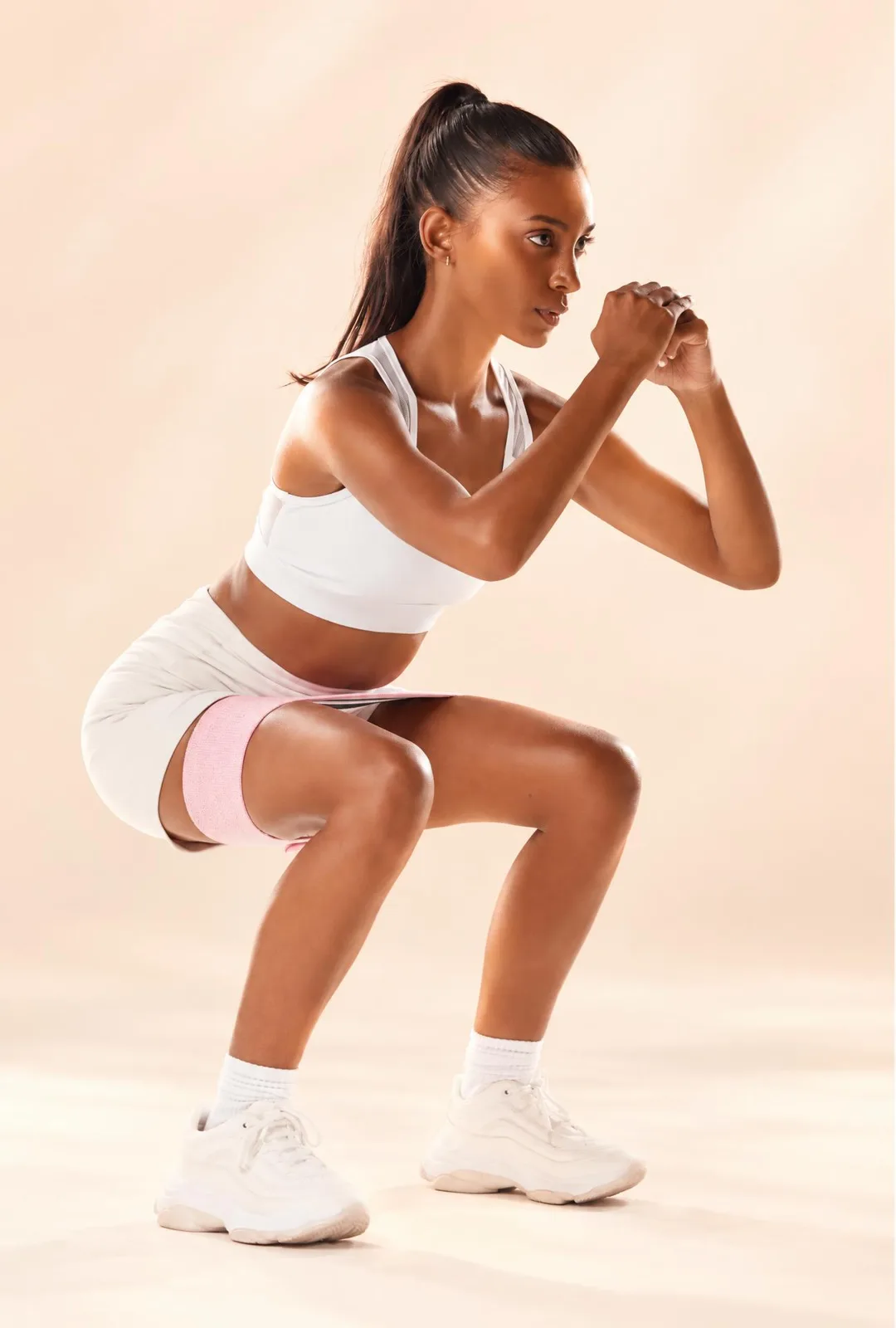
Bend your hips and knees at the same time and sit straight down between your feet. Let your knees move forward and follow the direction of your toes. Keep your whole foot on the floor, with weight spread across your heel, the ball of your foot and your big toe.
5. Find your depth
Go as low as you can while your heels stay down and your back stays long. For many people, that's thighs parallel to the floor or below. If you're using a box, touch it lightly without relaxing.
6. Stand up
Push the floor away with your whole foot and stand straight up. Keep your chest up and your knees tracking over your toes. Finish tall, squeezing your glutes at the top.
Quick form checklist
- Heels stay on the floor
- Knees follow the direction of your toes
- Torso stays long, not collapsing forward
- Depth is the same every rep
- You stand up smoothly, without bouncing
Filming one set from the side and one from the front is the fastest way to check your form.
How deep should you squat?
This is one of the most common questions, and the research is more reassuring than many people expect.
Deeper squats build more glute and inner thigh muscle
In a 2019 study in the European Journal of Applied Physiology, Kubo and colleagues had 17 men train either full squats or half squats twice a week for 10 weeks, with MRI scans of their muscles before and after. Both groups grew their quads by about the same amount, roughly 5%. But the full squat group grew their glutes about three times as much (6.7% vs 2.2%) and their adductors more than twice as much (6.2% vs 2.7%). Full squat strength also improved much more in the full squat group. Hamstrings didn't grow in either group.
A 2025 trial in 28 young male tennis players found no difference in thigh muscle size between full and half squats, and its authors called the research limited and mixed. Both studies were small and in men, so treat the numbers as a guide.
Are deep squats bad for your knees?
For healthy people, the evidence doesn't support that worry. A 2010 review in the Journal of Strength and Conditioning Research by Schoenfeld concluded that concerns about deep squats in healthy people were largely unwarranted, noting that forces on the knee ligaments actually drop at deep knee angles. It did flag that people with existing kneecap (patellofemoral) problems or ligament injuries may need to limit depth.
A 2016 narrative review by Hartmann and colleagues went further, arguing that half and quarter squats usually require heavier loads to challenge the same muscles, which may increase stress on the spine. The authors described deep and parallel squats done with good technique and gradual loading as beneficial.
What this means for you
- Squat as deep as you can with good form. For most beginners, aiming for at least parallel is a good target.
- Don't force depth. If your heels lift or your lower back rounds sharply at the bottom, stop a little higher for now and work on it over time.
- Use a box to build depth. Start at a height you can control, then lower it gradually.
Can your knees go past your toes?
The "never let your knees pass your toes" rule is one of the most repeated pieces of gym advice. Here's where it comes from and why it's mostly outdated.
When your knees travel forward, your knee joint does take on more of the work. That's the basis of the rule. But stopping your knees from moving forward has a cost.
In a 2003 study in the Journal of Strength and Conditioning Research, Fry and colleagues had lifters squat normally and then squat with a barrier stopping their knees from moving forward. Restricting the knees reduced knee torque by about 22%, but increased hip torque by more than 1,000%, as people had to lean much further forward to stay balanced. In other words, the load didn't disappear; it moved to the hips and lower back. The 2016 Hartmann review similarly called the instruction to restrict forward knee movement a misreading of the research.
The 2010 Schoenfeld review took a more cautious line, suggesting people avoid excessive forward knee travel, but warned against doing that at the expense of hip and spine position.
What this means for you
- Let your knees move forward naturally. For most people, especially those with longer legs, some forward knee travel is needed to squat deep with an upright torso.
- Focus on what matters more: heels down, knees tracking in line with your toes, and a controlled descent.
- If forward knee travel bothers a sore knee, a box squat, slightly wider stance or sitting back a little more can shift some load to the hips. Get it checked by a physio.
Common squat mistakes beginners make
- Heels lifting off the floor. Usually a sign of limited ankle mobility or a stance that's too narrow. Try a slightly wider stance, turn your toes out a bit more, or put small plates under your heels while you work on ankle mobility.
- Knees caving in. As you stand up, think about pushing your knees out in line with your toes. If it keeps happening, lighten the weight.
- Leaning too far forward. A goblet squat helps; so does keeping your chest up and the weight close.
- Going too heavy, too soon. If depth gets shallower or form changes as you add weight, the weight is too heavy.
- Bouncing out of the bottom. Control the descent, then stand up smoothly. A 2 to 3 second lowering is a good starting point.
- Holding your breath the whole set. Brace for each rep, then breathe at the top between reps.
How much should you squat as a beginner?
There's no universal starting number. Here's how to find yours.
Step 1: Learn the movement first
Spend a session or two on bodyweight box squats, then light goblet squats, until the setup feels natural.
Step 2: Find a working weight
Pick a weight you can squat for 8 to 12 reps with good form and about 2 to 3 reps left in the tank. If you could have done five or more extra reps, go heavier next set. If your depth got shallower or your form broke down, go lighter.
Step 3: Progress gradually
Use the same weight until you can do all your sets at the top of your rep range with clean form, then add a small amount, often 5 to 10 lb for lower-body exercises. This is the same progressive overload approach that works for every lift.
Sample beginner squat progression
| Weeks | Variation | Sets and reps |
|---|---|---|
| 1 to 2 | Box squat or bodyweight squat to a bench | 3 sets of 10 to 12 |
| 3 to 6 | Goblet squat | 3 sets of 8 to 12 |
| 7 to 10 | Goblet squat (heavier) or Smith machine squat | 3 sets of 8 to 10 |
| 10+ | Back or front squat, if you want to keep progressing | 3 sets of 6 to 10 |
These are common beginner coaching choices, not fixed rules. Some people never move beyond goblet squats and leg presses, and that's fine.
When to see a physio or doctor
- Sharp pain in or around your knee during or after squats, especially at the front of the knee
- Clicking or locking with pain, swelling, or a feeling that your knee might give way
- Hip or groin pain that's sharp or pinching at the bottom of the squat
- Back pain that lasts more than a few days or radiates down your leg
- Pelvic floor symptoms like leaking, heaviness or pressure when you squat
- If you're pregnant or postpartum, before starting or returning to loaded squats
Tired, slightly sore quads and glutes the next day are normal. Sharp joint pain is not.
Put it together: your week
Squats fit best into a full-body or lower-body routine. Here's how to connect them with the rest of your training, food, sleep and energy.
Where squats go in your week
| Day | Session |
|---|---|
| Monday | Full-body A: goblet squat, chest press, seated row, plank |
| Wednesday | Rest or a walk |
| Thursday | Full-body B: Romanian deadlift, split squat, lat pulldown, shoulder press |
| Weekend | Something active you enjoy |
- Do squats early in the session, after your warm-up, when you're fresh.
- Pair squats with a hinge like the Romanian deadlift during the week, so you train both the front and back of your legs.
Food, sleep and energy
- Eat enough protein to recover: most women who lift do well with about 1.2 to 1.6 g per kg of body weight a day.
- After a bad night's sleep, keep squats lighter and focus on clean reps instead of adding weight.
- Low energy or achy knees? Swap squats for a box squat or leg press at a lighter weight, and save the heavier work for another day.
Frequently asked questions
How do I squat for the first time?
Start with bodyweight squats to a bench, then goblet squats with a light dumbbell. Stand with your feet shoulder-width, toes slightly out, brace, sit down between your hips with your heels flat, and stand up by pushing the floor away. Do 3 sets of 10 to 12 reps.
Is it bad if my knees go past my toes when I squat?
No, for most people. A study found that blocking the knees from moving forward reduced knee load but sharply increased the load on the hips and lower back. Focus on keeping your heels down and your knees in line with your toes instead.
How deep should a beginner squat?
As deep as you can while your heels stay down and your back stays long, ideally to parallel or below. A 2019 study found full squats built more glute and inner thigh muscle than half squats. Use a box to build depth gradually if needed.
Are deep squats bad for your knees?
Not for healthy knees, according to research reviews. Forces on the knee ligaments actually drop at deep knee angles. If you have existing kneecap pain or a ligament injury, talk to a physio about the right depth for you.
Conclusion
Learning how to squat as a beginner is mostly about building a consistent pattern. Start with a goblet squat or box squat, set up the same way every rep, sit down between your hips with your heels flat, and let your knees move forward naturally. Go as deep as your form allows, and add weight in small steps.
The research is reassuring: deeper squats seem to build more glute and inner thigh muscle, and they aren't harmful for healthy knees. Get help from a physio if you have joint pain or pelvic floor symptoms, then give it a few weeks. Sitting down and standing up will start to feel easier, and so will the squat rack.
This article is for general education and isn't medical advice.
If you want help putting this into your own week, Wellio is an AI coach that sees the whole picture: it builds your plan around your workouts, meals, sleep and energy, and guides you day by day as life changes. Tell it your goal, schedule and equipment to get a starting plan with the right squat variation, log your sets as you go, and get suggestions for when to add weight. Join the Wellio waitlist.
Sources
- Kubo K, Ikebukuro T, Yata H. Effects of squat training with different depths on lower limb muscle volumes. European Journal of Applied Physiology, 2019link.springer.com
- Hammami R, et al. Full Squats Enhance Performance and Body Composition, but Not Hypertrophy, Compared to Half Squats in Elite Young Tennis Players. Journal of Functional Morphology and Kinesiology, 2025mdpi.com
- Schoenfeld BJ. Squatting kinematics and kinetics and their application to exercise performance. Journal of Strength and Conditioning Research, 2010lookgreatnaked.com
- Hartmann H, et al. Stress for Vertebral Bodies and Intervertebral Discs with Respect to Squatting Depth. Journal of Functional Morphology and Kinesiology, 2016mdpi.com
- Fry AC, Smith JC, Schilling BK. Effect of knee position on hip and knee torques during the barbell squat. Journal of Strength and Conditioning Research, 2003 (Physio Network summary)physio-network.com
Make it work
for your week.