How to Do a Push Up
for BeginnersProgressions and an 8-Week Plan
How to do a push up for beginners: the progressions from wall to floor, how hard each one really is, an 8-week plan, and the form cues that make reps count.
 By Wellio
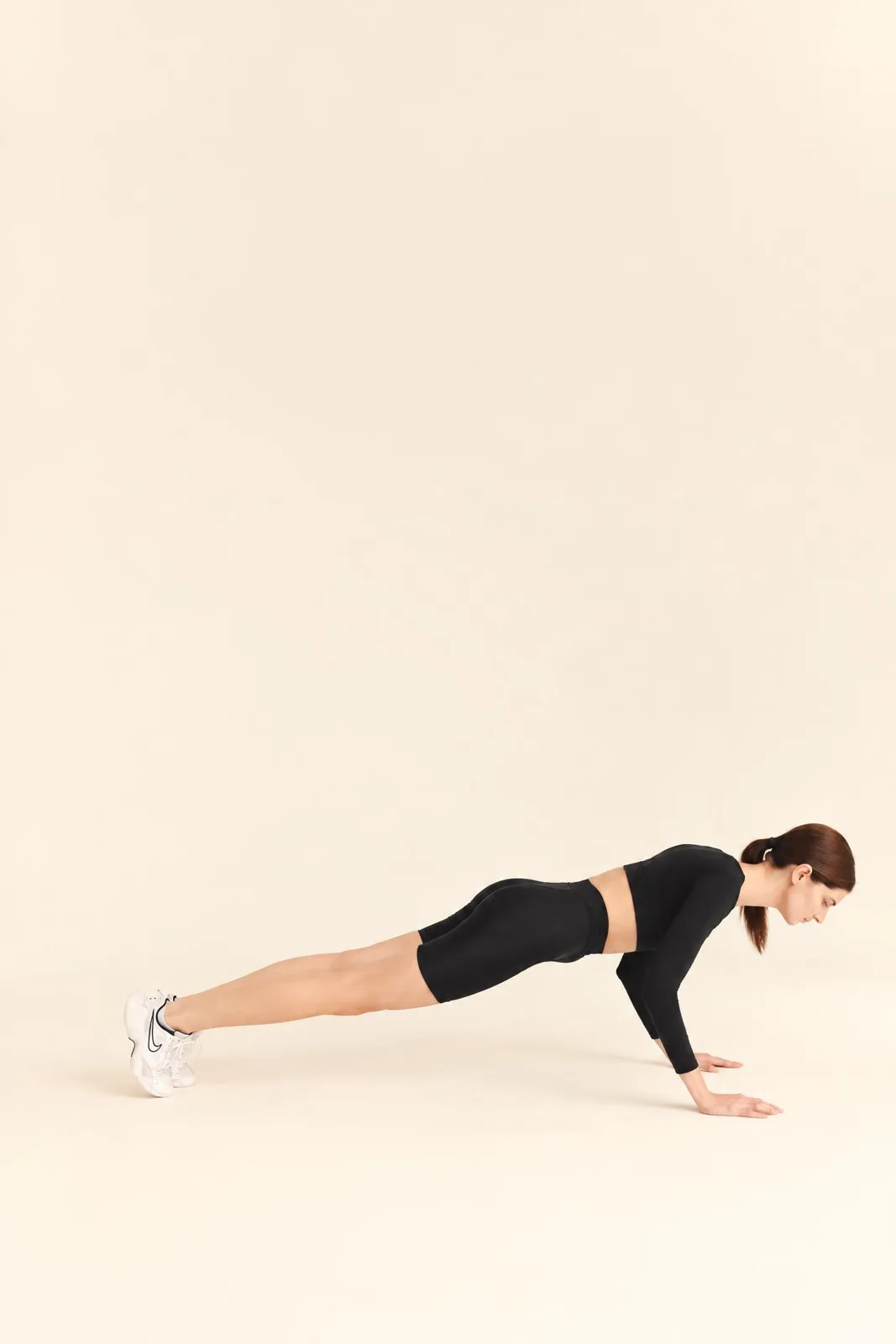
You drop down to do a push-up in class, lower yourself an inch, and your arms start shaking. Or you go all the way down and can't get back up. So you switch to your knees, feel like you're "cheating," and never really know whether you're getting closer to the real thing.
A push-up is harder than it looks. In a standard push-up, your hands push roughly two-thirds of your body weight, and you have to hold your whole body in a straight line while you do it. Struggling with it doesn't mean you're weak. It means you need a version that matches your current strength, and a clear path to the next one.
We built this guide from biomechanics research on how much load each push-up variation puts on your arms, plus training studies comparing push-ups with the bench press. Below: the progressions ranked by difficulty, whether push-ups build real strength, an 8-week plan, testing, form cues, and wrist and shoulder care.
What a push-up actually requires
A full push-up means holding a straight plank on your hands and toes, lowering your chest close to the floor, and pressing back up without your hips sagging or piking. To do it, you need:
- Pushing strength in your chest, shoulders and triceps.
- Core strength to keep your body in a straight line from head to heels.
- Shoulder blade control, so your upper back stays stable as you move.
- Strength relative to your body weight. Like a pull-up, you can't choose a lighter load on the floor. The load is a large share of you.
That's why progressions matter: changing your body angle changes how much weight your arms push, so you can train the same movement at a load you can handle.
How much of your body weight you push in each version
This is the most useful research for beginners, because it shows exactly how much easier or harder each variation is.
Researchers have measured how much force goes through the hands in different push-up positions. A 2012 review in the Strength and Conditioning Journal by Contreras, Schoenfeld and colleagues pulled these studies together. Here's what they show:
| Push-up version | Approximate share of body weight on your hands |
|---|---|
| Hands on a 24-inch (61 cm) box or bench | About 41% |
| Knee push-up | About 49% to 62% |
| Hands on a 12-inch (30 cm) box or step | About 55% |
| Full push-up on the floor | About 64% to 75% |
| Feet on a 12-inch box | About 70% |
| Feet on a 24-inch box | About 74% |
These numbers come from small groups, often of trained men, and the ranges reflect different studies and positions, so treat them as a guide. Wall push-ups weren't measured, but with your body almost upright they load your arms far less than anything in the table.
The surprising takeaway: a knee push-up and an incline push-up with your hands on a low step are in the same difficulty range. The incline version has one advantage: you're already practicing the full plank position from your toes, so it often carries over to the floor more naturally. Knee push-ups are still a perfectly good option, especially at home with nothing to lean on.
The push-up progressions, from easiest to hardest
Here are the progressions we recommend, in order. Use the first one you can do for 6 to 8 clean reps.
| Step | Progression | How to do it | Move on when you can do |
|---|---|---|---|
| 1 | Wall push-up | Hands on a wall at chest height, feet a step or two back | 3 sets of 8, easy |
| 2 | High incline push-up | Hands on a kitchen counter or high bench (about hip height) | 3 sets of 8 |
| 3 | Medium incline push-up | Hands on a gym bench, sturdy chair or box (about knee to mid-thigh height) | 3 sets of 8 |
| 4 | Low incline push-up or knee push-up | Hands on a low step or the lowest box, or knees on the floor | 3 sets of 8 |
| 5 | Slow negatives | Start at the top of a full push-up, lower for 3 to 5 seconds, reset on your knees | 3 sets of 5 controlled lowers |
| 6 | Full push-up | Hands and toes on the floor, full range | Your first clean rep, then sets of 3 to 5 |
A few tips:
- In a gym, a Smith machine bar is a great tool. Set it at a height, do your incline push-ups on it, and lower it one notch at a time.
- Knee push-ups still need a straight line from your knees to your head.
The move-on targets are common coaching standards, not research findings. They work well because they ensure you're strong for several reps before the next step gets harder.
Do push-ups build real strength?
Yes, as long as they're hard enough.
- Push-ups vs bench press, matched loads. A 2015 study in the Journal of Strength and Conditioning Research (Calatayud and colleagues) trained 30 experienced lifters for 5 weeks. One group did the bench press and another did push-ups made harder with elastic bands, so both worked at a similar effort. Both groups improved their bench press strength by a similar amount; a control group didn't change.
- Push-ups vs light bench press. A 2017 study in the Journal of Exercise Science & Fitness (Kikuchi and Nakazato) had 18 young men do either light bench press or push-ups at a matched load, twice a week for 8 weeks. Both groups gained similar bench press strength and chest and triceps muscle thickness.
- Progressive push-ups vs bench press. A 2018 study in the Journal of Strength and Conditioning Research (Kotarsky and colleagues) had 23 moderately trained adults do either bench press or push-ups that progressed through harder variations, 3 times a week for 4 weeks. Both groups got stronger on the bench press with no significant difference between them. Neither group gained measurable muscle size in that short window.
Most participants were young men or trained lifters, so the numbers may not apply exactly to beginner women. And push-ups only matched the bench press when they were made hard enough. Twenty easy knee push-ups at the end of a class won't do the same thing.
How to do a push up for beginners: your 8-week plan
Here's a simple 8-week plan. The structure is a common coaching approach, and the move-on rule is the one used in the 2018 progressive push-up study: when you hit 3 sets of 8 for two sessions in a row, move to a harder version.
Train push-ups 2 to 3 times a week, with at least one rest day between sessions. Do them at the start of a workout, after a warm-up, when you're fresh.
Weeks 1 and 2: find your level
- Test: try the progressions from the top of the table down. Your starting level is the hardest one you can do for 6 to 8 clean reps.
- Each session: 3 sets of 6 to 8 reps at your level. Rest 60 to 90 seconds.
- Add: a 20 to 30 second plank, 2 times. A strong plank is half of a good push-up.
Weeks 3 and 4: progress and add negatives
- Each session: 3 sets at your current level. When you hit 3 sets of 8 two sessions in a row, move down one step.
- Add: 2 sets of 3 slow negatives from the full push-up position (lower for 3 to 5 seconds, drop to your knees, reset at the top).
- Keep: the planks, building toward 30 to 45 seconds.
Weeks 5 and 6: get closer to the floor
- Each session: 3 sets at your new level, which for many people is now a low incline or knee push-up.
- Increase negatives: 3 sets of 3 to 5, aiming for a slower, more controlled descent.
- Try: one "test rep" from the floor at the start of a session, if negatives feel strong.
Weeks 7 and 8: build your first full reps
- Each session: start with full push-up attempts (as many good reps as you can, up to 3 sets). Then finish with 2 sets at your previous level.
- If you can't get a full rep yet: keep doing negatives and your lowest incline. It's not a failure; it's the plan doing its job.
- Once you have 1 to 3 full reps: build toward sets of 5, then 8.
How hard should each set feel?
Stop each set when you have about 1 to 2 good reps left, or when your form starts to break: hips sagging, head dropping, or elbows flaring wide. Grinding out ugly reps teaches the wrong pattern. For more on choosing effort and progressing over time, see our guide to progressive overload.
How to test your push-up progress
Testing tells you whether the plan is working, even before your first full rep.
Every 2 weeks, at the start of a session after your warm-up:
- Do as many good reps as you can at your current level. Write down the number.
- Do 1 slow negative from the floor and count how many seconds you can control it.
- Hold a plank and note how long you can keep a straight line.
For a broader look at upper-body strength, the same patient approach works for pulling too. Our guide on how to do a pull up uses a similar progression system.
Push-up form cues that make every rep count
Set up
- Hands slightly wider than your shoulders, fingers spread, under or slightly outside your chest.
- Body in one straight line from head to heels (or head to knees). Squeeze your glutes and brace your stomach as if someone were about to poke it.
- Eyes on the floor slightly ahead of your hands, so your neck stays neutral.
Lowering
- Elbows at roughly 30 to 45 degrees from your body, not flared straight out to the sides. Picture an arrow shape, not a T. This is a common coaching cue that many people find more comfortable on the shoulders.
- Chest leads, not your head or hips. Lower until your chest is a few inches from the surface, then push the floor away and finish with straight arms.
Common mistakes
| Mistake | What it looks like | Fix |
|---|---|---|
| Sagging hips | Lower back dips toward the floor | Squeeze glutes, raise your hands to an easier height |
| Piked hips | Butt in the air | Bring hips into line, think "plank that moves" |
| Head dropping | Nose reaches the floor first | Look slightly ahead, lead with your chest |
| Half reps | Only bending elbows a little | Use a higher surface so you can go deeper |
| Elbows flared wide | Arms in a T shape | Tuck elbows toward an arrow shape |
Wrist and shoulder tips
Push-ups put weight through your wrists and shoulders, so a little care goes a long way. These are general practical tips, not research findings.
- Wrist discomfort: try push-up handles, holding dumbbells on the floor (hex dumbbells that won't roll), or making a fist with a straight wrist on a padded surface. Warming up with gentle wrist circles also helps many people.
- Shoulder discomfort: tuck your elbows a bit more, reduce your range, or move up to a higher incline for a while.
- Warm up first: a few minutes of light movement and a set at an easier version prepares your shoulders. See our guide on how to warm up before lifting.
Stop and see a doctor or physio if you feel sharp pain, pain that lingers after training, numbness or tingling in your hands, or a shoulder that feels unstable. If you're pregnant or postpartum, talk to your doctor or a pelvic health physio before doing push-ups or planks, since they put a lot of demand on the abdominal wall.
Put it together: your week
Push-ups work best as part of a full plan, supported by food, sleep and recovery.
A sample week
| Day | Session |
|---|---|
| Monday | Full-body strength, starting with push-up progressions (3 sets) plus negatives |
| Tuesday | Walk, class or rest |
| Wednesday | Full-body strength, starting with push-up progressions plus a plank |
| Thursday | Rest |
| Friday | Optional short session: push-up test day every other week, plus lower body |
| Weekend | Rest or something active you enjoy |
If you train at home, push-ups fit neatly into a dumbbell routine. Our dumbbell workout at home for beginners already includes them, and this plan can replace the push-up slot in that program.
Supporting your progress
- Train pulling as much as pushing. Rows and pulldowns keep your shoulders balanced as your push-ups improve.
- Eat enough protein. Most women who lift do well with about 1.2 to 1.6 g of protein per kg of body weight a day, spread across meals.
- Sleep matters. After a bad night, stop sets further from failure and skip test days.
Frequently asked questions
How do I do a push-up if I can't do one at all?
Start with a wall or high incline push-up, with your hands on a wall or kitchen counter. Do 3 sets of 6 to 8 reps, 2 to 3 times a week, and lower the surface each time you can do 3 sets of 8. Add slow negatives from the floor after a few weeks.
Are knee push-ups or incline push-ups better for beginners?
Both work. Research shows a knee push-up and an incline push-up with hands on a low step load your arms by a similar amount. Incline versions practice the full plank from your toes, so they often transfer to the floor more easily, but knee push-ups are a great choice when you have nothing to lean on.
How long does it take to do your first push-up?
It depends on your starting strength. Many beginners get there in 4 to 8 weeks of training 2 to 3 times a week, but some take longer. Track reps and incline height so you can see progress before your first full rep.
Are push-ups as good as the bench press?
For building strength, they can be. Studies found push-ups produced similar bench press strength gains when they were made hard enough with bands, harder variations or matched loads. The bench press is easier to load heavily over time, so many people use both.
Conclusion
Learning how to do a push up as a beginner isn't about forcing your way through shaky reps on the floor. It's about picking the right version for your current strength, doing 3 good sets 2 to 3 times a week, and moving to a harder version when 3 sets of 8 feel solid. Lowering your hands a little at a time, adding slow negatives, and keeping a strong plank will get you there.
Push-ups build real strength when you keep progressing them. Give the plan 8 weeks and let your numbers show your progress.
This article is for general education and isn't medical advice.
If you want help putting this into your own week, Wellio is an AI coach that sees the whole picture: it builds your plan around your workouts, meals, sleep and energy, and guides you day by day as life changes. Tell it your goal, schedule and whether you train at home or in a gym to get a starting plan, log each set and push-up version, and get suggestions for when to move to a harder one. Join the Wellio waitlist.
Sources
- Contreras B, Schoenfeld B, Mike J, Tiryaki-Sonmez G, Cronin J, Vaino E. The Biomechanics of the Push-up: Implications for Resistance Training Programs. Strength and Conditioning Journal, 2012bretcontreras.com
- The effect of position on the percentage of body mass supported during traditional and modified push-up variants. Journal of Strength and Conditioning Research, 2011pubmed.ncbi.nlm.nih.gov
- Wurm B, et al. Kinetic analysis of several variations of push-ups. ISBS Conference Proceedings, 2010ojs.ub.uni-konstanz.de
- Calatayud J, et al. Bench press and push-up at comparable levels of muscle activity results in similar strength gains. Journal of Strength and Conditioning Research, 2015pubmed.ncbi.nlm.nih.gov
- Kikuchi N, Nakazato K. Low-load bench press and push-up induce similar muscle hypertrophy and strength gain. Journal of Exercise Science & Fitness, 2017doaj.org
- Kotarsky CJ, Christensen BK, Miller JS, Hackney KJ. Effect of progressive calisthenic push-up training on muscle strength and thickness. Journal of Strength and Conditioning Research, 2018 (summary by Sciences du Sport)sci-sport.com
- AAFP. Dietary Guidelines for 2025 to 2030 (protein recommendation)aafp.org
Make it work
for your week.