Core Exercises for
Beginners at the GymWhat to Do and Why
Core exercises for beginners at the gym: the 4 jobs your core does, the best moves on machines, cables and the floor, and two 10-minute finishers to try.
 By Wellio
You finish your workout, head to the mats, and do whatever the person next to you is doing: a few crunches, a plank you hold until you get bored, maybe some Russian twists. It feels like core work. But you're not sure it's doing anything, and you've heard both "crunches are useless" and "you need to train abs every day."
This guide fixes that. We explain what your core actually does, give you the best beginner exercises for each job using gym machines, cables and the floor, and show how to fit them into your week with two 10-minute finishers. We also cover what research says about burning belly fat with ab exercises, whether squats and deadlifts already train your core, and when to check with a pelvic health physio first.
What is your core, and what does it do?
Your core is more than your "abs." It includes the rectus abdominis (the six-pack muscle), the obliques on your sides, the deep transverse abdominis, the muscles along your spine, your glutes and hips, the diaphragm and the pelvic floor. Together they keep your trunk steady while your arms and legs move, and they move your spine when you bend or twist.
Coaches usually sort core training into four jobs:
| Job | What it means | Everyday example |
|---|---|---|
| Anti-extension | Stopping your lower back from arching | Carrying a laundry basket out in front |
| Anti-rotation | Stopping your trunk from twisting | Opening a heavy door with one hand |
| Anti-lateral flexion | Stopping your body from bending sideways | Carrying a heavy bag in one hand |
| Flexion | Curling your spine forward | Sitting up from lying down |
The first three are about holding your trunk still against a force. The fourth is about moving it. A good beginner routine trains all four instead of doing ten versions of the same crunch.
The best core exercises for beginners at the gym
Here are reliable beginner options for each job, with a machine or cable version, a bodyweight version and a way to progress.
Anti-extension (resist arching)
| Exercise | Equipment | How to do it | Make it harder |
|---|---|---|---|
| Front plank | Floor | Forearms under shoulders, squeeze glutes, ribs down, hold 20 to 30 seconds | Longer holds, then plank with alternating shoulder taps |
| Dead bug | Floor | On your back, arms up, knees over hips. Slowly lower opposite arm and leg while keeping your lower back on the floor | Hold a light dumbbell or add a band |
| Ab wheel from knees | Ab wheel | Kneel, roll forward only as far as you can without your back arching, then pull back | Roll farther out, then progress toward standing |
Anti-rotation (resist twisting)
| Exercise | Equipment | How to do it | Make it harder |
|---|---|---|---|
| Pallof press | Cable or band | Stand side-on to the cable, press the handle straight out, hold 2 to 3 seconds without twisting | Step farther away, add weight, or kneel on one knee |
| Bird dog | Floor | On hands and knees, reach opposite arm and leg out without your hips tipping | Pause longer, or add a light ankle weight |
| Half-kneeling cable chop | Cable | Kneeling on one knee, pull the cable diagonally across your body with your hips facing forward | Add weight or slow the return |
If you've read our guide to cable machine exercises for beginners, you'll recognize the Pallof press and woodchop. They're two of the most useful core moves in the gym, which is why they show up again here.
Anti-lateral flexion (resist side bending)
| Exercise | Equipment | How to do it | Make it harder |
|---|---|---|---|
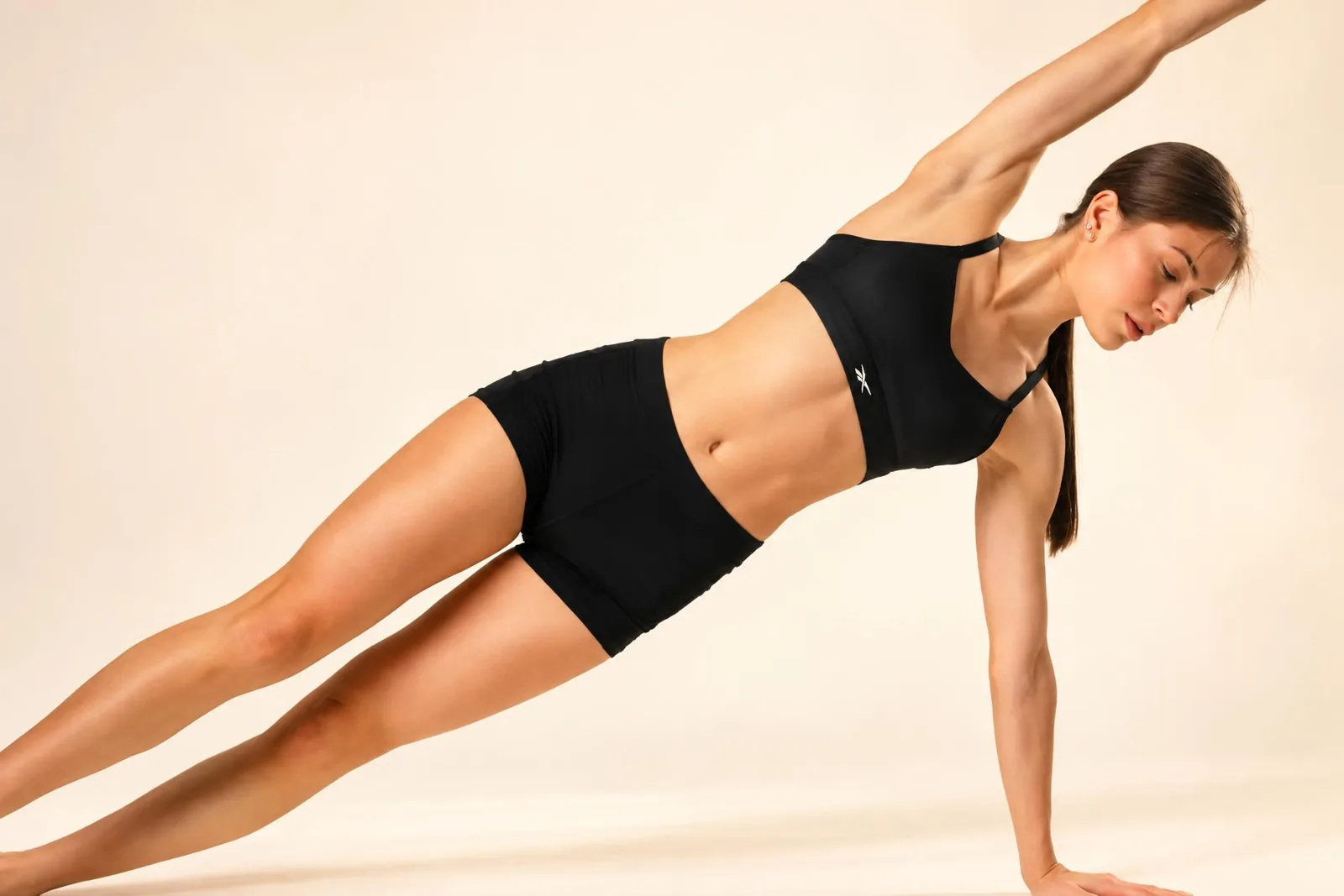
| Side plank | Floor | Elbow under shoulder, body in a straight line, start on knees if needed | Straight legs, longer holds, top leg raised |
| Suitcase carry | Dumbbell or kettlebell | Hold one heavy weight at your side and walk tall without leaning | Heavier weight or longer walk |
Flexion (curl the spine)
| Exercise | Equipment | How to do it | Make it harder |
|---|---|---|---|
| Cable crunch | Cable with rope | Kneel facing the machine, rope by your head, curl your ribs toward your hips | Add weight in small steps |
| Reverse crunch | Floor or bench | On your back, knees bent, curl your hips off the floor toward your ribs | Slow the lowering, or do it on an incline bench |
| Ab crunch machine | Machine | Set the seat so the pads sit at your chest, curl forward slowly | Add weight |
| Dead hang knee raise | Pull-up bar or captain's chair | Hang or support on forearms, raise knees toward chest without swinging | Raise knees higher, then straighter legs |
Do crunches work?
Crunches get a bad reputation online, but they do train the rectus abdominis. They're simply one tool among many.
The useful way to think about crunches: they train the flexion job, which is one of four. A routine made only of crunches and sit-ups leaves out the bracing and anti-rotation work your core uses most when you lift, carry or move through your day. Adding a cable crunch or reverse crunch to a routine that also includes planks, Pallof presses and carries gives you balance.
Can you spot reduce belly fat with ab exercises?
This is the most common reason people do ab workouts, so it deserves a straight answer: research doesn't support it.
In a 2011 study in the Journal of Strength and Conditioning Research, researchers at Southern Illinois University Edwardsville assigned 24 sedentary adults to either no exercise or an abdominal program: 2 sets of 10 reps of seven ab exercises, five days a week, for six weeks. The ab group got better at curl-ups, but their abdominal fat, waist size and body composition did not change.
A 2013 study by Ramírez-Campillo and colleagues tested the idea another way. Eleven young adults trained only one leg for 12 weeks. Fat mass went down across the whole body, but not in the trained leg. The fat that was lost came mostly from the upper body and trunk.
The research isn't perfectly uniform. Some smaller studies have reported local changes, and a summary in The Conversation described the evidence as mixed, while noting that a recent meta-analysis found no spot-reduction effect. On balance, training a muscle doesn't selectively burn the fat on top of it.
What does this mean for you? Core training is worth doing for strength, stability and how your body feels when you lift and move. How much fat you carry in any area mostly comes down to overall energy balance, genetics and hormones, and where your body stores fat is largely out of your control. Bodies come in many shapes, and a strong core doesn't always look a particular way.
Don't squats and deadlifts already train your core?
You'll often hear that heavy compound lifts are all the core training you need. There's some truth in it, but it's not the full picture.
A 2007 study by Hamlyn, Behm and Young at Memorial University of Newfoundland compared trunk muscle activity during squats and deadlifts with stability ball exercises. They found no significant differences in activation of the external obliques or the lower abdominal stabilizers between the lifts and the ball exercises, suggesting that heavy squats and deadlifts do work these muscles at least as much as typical "core" exercises. It was a small study in trained people, and variability between participants was high.
Our practical reading: big lifts train your core to brace in a straight line, especially against arching and bending forward. They don't train much rotation control or side-to-side stability, and many beginners aren't lifting heavy enough yet for squats and deadlifts to challenge the core much. That's why a few minutes of dedicated work, especially anti-rotation and carries, is worth adding.
How to fit core training into your week
You don't need a separate "ab day." Most people get the best results by adding short core blocks to the workouts they already do. The guidance below is common coaching practice, not a tested prescription.
- Frequency: 2 to 3 times a week, at the end of your strength sessions.
- Volume: 2 to 3 exercises, 2 to 3 sets each. That's about 8 to 12 minutes.
- Order: Do core work after your main lifts, not before. A tired core before squats or deadlifts can make those lifts harder to brace.
- Effort: Treat core sets like any other set. Aim to finish with only a few reps or seconds left in the tank.
- Progression: Add 5 to 10 seconds to holds, add reps, or move up one small step on the cable or machine every week or two.
If you also take Pilates, that class already gives you a lot of core endurance and control. Our Pilates vs weight training article explains how the two fit together. On Pilates weeks, one core finisher after a lifting session may be plenty.
Two 10-minute core finishers
Here are two finishers you can rotate. Do them at the end of your strength workouts. Rest about 30 to 45 seconds between sets. The sets, reps and holds are common beginner starting points.
Finisher A: Stability focus
| Exercise | Sets | Reps or time |
|---|---|---|
| Dead bug | 2 | 6 to 8 per side, slow |
| Pallof press | 2 | 8 to 10 per side, 2-second hold |
| Suitcase carry | 2 | 20 to 30 steps per side |
Finisher B: Strength focus
| Exercise | Sets | Reps or time |
|---|---|---|
| Cable crunch | 2 to 3 | 10 to 12 |
| Side plank (knees or feet) | 2 | 20 to 30 seconds per side |
| Ab wheel from knees | 2 | 6 to 10 |
How to use them
- Two lifting days a week: Finisher A on day one, Finisher B on day two.
- Three lifting days a week: Alternate A, B, A one week and B, A, B the next.
- Progress: When you can hit the top of the rep or time range with good control on every set, make one exercise harder using the "make it harder" column above.
Safety notes: back pain, pregnancy and postpartum
Most people can start core training safely, but a few situations call for extra care.
If you have back pain
Exercise is one of the most effective treatments for chronic low back pain. A 2021 network meta-analysis in the Journal of Physiotherapy by Hayden and colleagues found most exercise types helped compared with minimal care, with Pilates among the most effective. Start with gentle bracing exercises like dead bugs and bird dogs, and skip anything that sharpens your pain. See a doctor or physio if your pain is severe, getting worse, or comes with numbness, tingling, weakness, or changes in bladder or bowel control.
If you're pregnant or postpartum
Pregnancy changes how your core and pelvic floor work. Diastasis recti abdominis, a separation of the left and right sides of the outer abdominal muscle, is common in pregnancy. According to the American Physical Therapy Association, it often resolves on its own in the first three months after birth, but it can persist. Signs include a visible gap or doming along the middle of your stomach when you lift, roll over or exercise, as well as low back, pelvic or hip pain.
A pelvic health physical therapist can check your abdominal wall and pelvic floor and tell you which movements to modify and how to progress. If you're pregnant or have recently given birth, talk to your doctor and consider a pelvic health physio before starting a core routine, especially exercises like crunches, ab wheels and heavy carries.
Put it together: your week
Core training works best as part of the whole picture, alongside your main training, food, sleep and energy.
- Training: Two or three full-body or upper/lower sessions, each finishing with 8 to 12 minutes of core work. If you're new to lifting, our guide on what to do at the gym as a beginner gives you the main session to build on.
- Food: If your goal includes looking more defined, that comes mostly from overall eating habits and consistent strength training, not from more ab exercises. Protein at each meal supports recovery from all your training.
- Sleep and energy: On a low-energy day, keep the core finisher short or skip it. It's the easiest part of the workout to drop without losing much.
- Tracking: Write down your holds, reps and cable weights. Seeing a side plank go from 20 to 45 seconds is a clear sign you're getting stronger.
A sample week:
- Monday: Strength session, then Finisher A
- Wednesday: Strength session, then Finisher B
- Friday: Strength session, then Finisher A
- Weekend: A walk, a Pilates class, or rest
Frequently asked questions
What are the best core exercises for beginners at the gym?
Good starting points are the dead bug, front plank, Pallof press, side plank, suitcase carry and cable crunch. Together they cover the four jobs your core does: resisting arching, twisting and side bending, plus curling your spine.
How often should beginners train core?
Two to three times a week is plenty for most beginners. Add 8 to 12 minutes of core work at the end of your strength sessions rather than doing a separate ab day.
Do ab exercises burn belly fat?
Not specifically. A 2011 study found six weeks of daily ab exercises improved abdominal endurance but didn't change belly fat or waist size. Core training builds strength; overall fat loss depends mainly on overall eating and activity.
Do I need core work if I do squats and deadlifts?
Big lifts do work your core, and one study found trunk muscle activity during squats and deadlifts was similar to stability ball exercises. Adding a few anti-rotation and side-to-side exercises fills the gaps that compound lifts miss.
Are planks better than crunches?
They train different jobs. Planks train your core to resist arching, while crunches train it to curl your spine. A balanced routine includes both types, plus anti-rotation and side-bending work.
Is core training safe after having a baby?
It can be, but get guidance first. Talk to your doctor and consider seeing a pelvic health physical therapist, who can check for diastasis recti and pelvic floor issues and tell you how to progress safely.
Conclusion
Core exercises for beginners at the gym don't need to be complicated. Your core's main job is keeping your trunk steady, so train it against arching, twisting and side bending, with a bit of curling. Add 8 to 12 minutes after your strength workouts two or three times a week, and make one exercise harder every week or two.
Train your core for what it does: helping you lift, carry and move with more control. It won't burn fat from one spot, and that's fine. A stronger core makes everything else in your training work better.
This article is for general education and isn't medical advice.
If you want help putting this into your own week, Wellio is an AI coach that sees the whole picture: it builds your plan around your workouts, meals, sleep and energy, and guides you day by day as life changes. Answer a few questions to get a starting plan with core work built into your sessions, log your sets and holds, and get suggestions for when to make each exercise harder. Join the Wellio waitlist.
Sources
- Vispute SS, et al. The effect of abdominal exercise on abdominal fat. Journal of Strength and Conditioning Research, 2011 (IDEA Health and Fitness summary)ideafit.com
- Ramírez-Campillo R, et al. Regional fat changes induced by localized muscle endurance resistance training. Journal of Strength and Conditioning Research, 2013repositorio.unab.cl
- The Conversation. Spot reduction: why exercise probably can't help you target fatty areas of the bodytheconversation.com
- Hamlyn N, Behm DG, Young WB. Trunk muscle activation during dynamic weight-training exercises and isometric instability activities. Journal of Strength and Conditioning Research, 2007 (Memorial University thesis)research.library.mun.ca
- Hayden JA, et al. Some types of exercise are more effective than others in people with chronic low back pain: a network meta-analysis. Journal of Physiotherapy, 2021latam-cl.demo.elsevierpure.com
- American Physical Therapy Association (ChoosePT). Physical Therapy Guide to Diastasis Rectus Abdominis, 2020choosept.com
Make it work
for your week.