Cable Machine Exercises
for BeginnersHow to Use It and 11 Moves to Start With
Cable machine exercises for beginners: how to set the pulley and pick attachments, 11 easy moves with cues, and a simple 2-workout cable plan for women.
 By Wellio
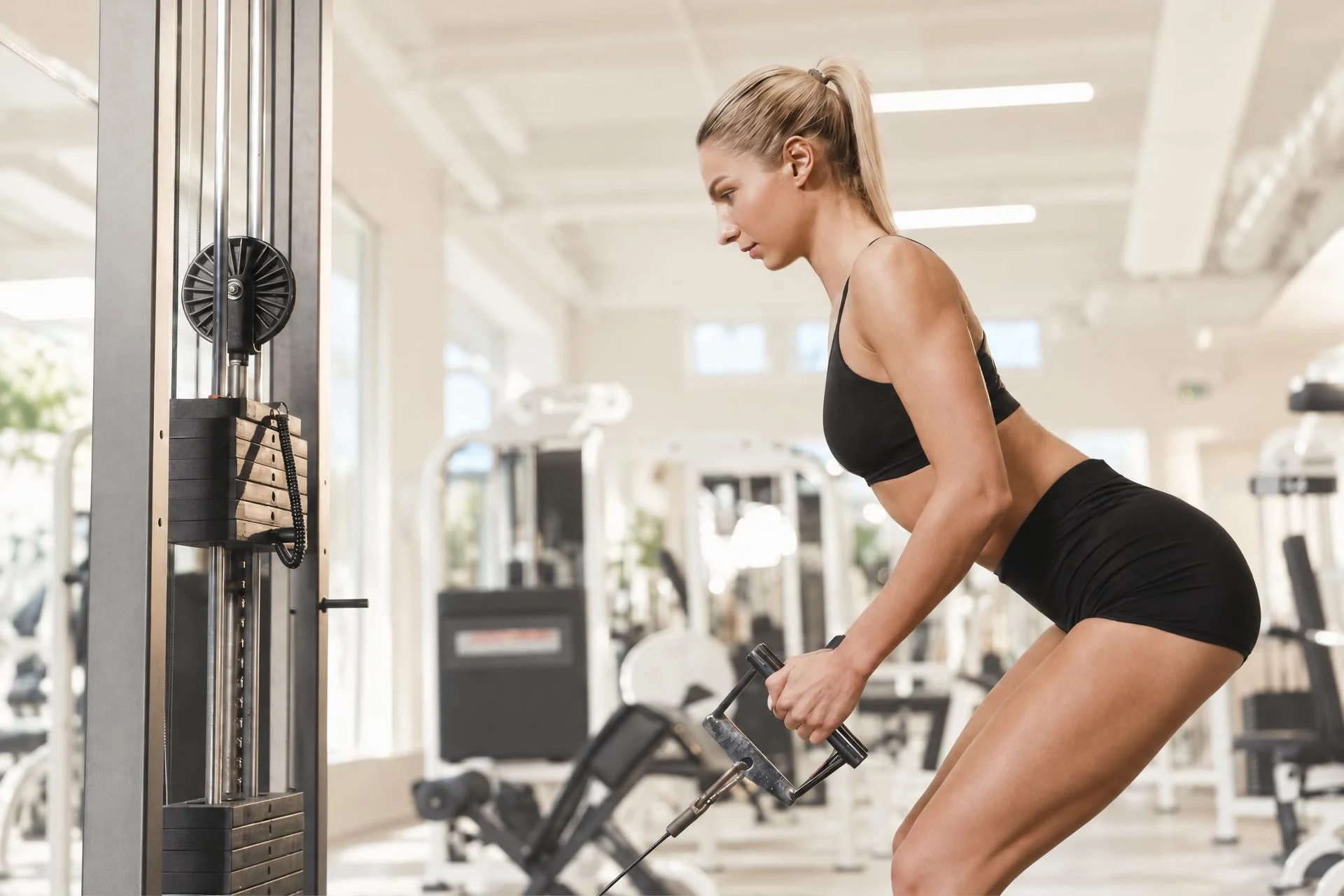
You've walked past the cable machine a dozen times. It's the tall tower with pulleys, a pile of handles hanging off a hook, and someone doing something complicated with a rope. You'd like to use it, but you're not sure how to change the height, which attachment to grab, or what to actually do once you're there.
That's normal. Cable machines are one of the most useful pieces of equipment in a gym, and one of the least explained. One station can train your back, chest, shoulders, arms, glutes and core, and it's easy to adjust in small steps. But nobody hands you instructions.
This guide is the instruction sheet. We cover how the machine works, which attachments do what, what the research says about cables versus free weights, 11 beginner exercises with setup and cues, a simple two-workout plan, gym etiquette and the most common mistakes. If you're brand new to the gym, start with our first-week beginner plan, then come back here when you're ready to add cables.
How to use a cable machine: the parts that matter
Most gyms have one of two setups: a single cable tower (one adjustable pulley) or a cable crossover (two towers side by side, often with a pull-up bar between them). They work the same way.
- The weight stack: a column of plates. You choose the weight by sliding a pin into the hole under the plate you want.
- The pulley: the wheel the cable runs through. On most machines you can slide it up and down a track by pulling a pop pin, then letting it click into place.
- The cable and clip: a carabiner on the end of the cable, where you attach a handle, rope or bar.
- The attachment hook: usually on the side of the tower, where gyms keep the handles.
One thing that surprises beginners: the number on the stack isn't the same on every machine. Different pulley designs change how heavy a given plate feels, so 20 on one machine might feel very different from 20 on another. Write down which machine you used, not just the number.
Setting the pulley height
| Pulley position | Used for |
|---|---|
| High (above your head) | Lat pulldown, triceps pushdown, face pull, high-to-low woodchop |
| Middle (chest height) | Pallof press, chest fly, standing row |
| Low (near the floor) | Biceps curl, pull-through, glute kickback, lateral raise, low-to-high woodchop |
Which attachment to use
| Attachment | What it looks like | Common exercises |
|---|---|---|
| Single D-handle | A stirrup-shaped grip | Single-arm row, chest fly, lateral raise, Pallof press, woodchop |
| Rope | Two ends with knots or stoppers | Face pull, triceps pushdown, pull-through |
| Straight or EZ bar | A short metal bar | Biceps curl, triceps pushdown |
| V-handle (close grip) | A triangle-shaped handle | Seated row |
| Long lat bar | A wide bar | Lat pulldown (on a pulldown station or high pulley) |
| Ankle strap | A padded cuff with a ring | Glute kickback, hip abduction |
Cable vs free weights: are cables as good?
A 2023 systematic review and meta-analysis in BMC Sports Science, Medicine and Rehabilitation by Haugen and colleagues pooled 13 studies with 1,016 adults comparing free-weight and machine-based training. When the two were compared directly, there was no significant difference in strength, jump performance or muscle growth. Strength gains were somewhat specific to how people trained: those who trained with free weights did better on free-weight tests, and those who trained on machines tended to do better on machine tests. The authors concluded that the choice should come down to preference and goals. Note that this review covered machines in general, not cables specifically.
There's also a cable-specific study. A 2025 trial in Frontiers in Physiology by Larsen and colleagues had 24 experienced lifters train one arm with dumbbell lateral raises and the other with cable lateral raises for eight weeks. Both built the side of the shoulder by a similar amount, about 3% to 5% in muscle thickness. The researchers had expected the cable version to win; it didn't.
So why bother with cables? A few practical reasons:
- The pull follows the cable, not just gravity. That lets you load movements, like a Pallof press or face pull, that are awkward with dumbbells.
- Small, easy weight changes. Move a pin instead of hunting for the next dumbbell.
- Smooth and controlled. Many beginners find cables easier to learn than free weights, and it's simple to stop a rep partway if something feels off.
- One station, many exercises. Handy when the gym is busy.
11 cable machine exercises for beginners
Each exercise below includes the setup and two or three cues. The cues are standard coaching guidance. Start light on every move; the goal of your first few sessions is to learn the pattern.
Back and shoulders
1. Seated cable row
- Setup: Seated row station or low pulley, V-handle. Feet on the platform, knees slightly bent.
- Cues: Sit tall. Pull the handle toward your lower ribs, squeezing your shoulder blades together. Let your arms straighten fully without rounding forward.
2. Lat pulldown
- Setup: Pulldown station (or high pulley while kneeling), long bar. Thigh pad snug.
- Cues: Grip a little wider than your shoulders. Pull the bar to your upper chest by driving your elbows down. Don't lean far back or yank with momentum.
3. Face pull
- Setup: High pulley, about forehead height, rope attachment.
- Cues: Step back until the cable is tight. Pull the rope toward your face, splitting the ends apart, with elbows high. Pause, then return slowly. Use a light weight; this is a control exercise.
4. Cable lateral raise
- Setup: Low pulley, single D-handle. Stand side-on to the machine and hold the handle in the hand farther from it.
- Cues: With a slight bend in the elbow, raise your arm out to the side to about shoulder height. Lower slowly. Keep your shoulders down, away from your ears.
Chest and arms
5. Cable chest fly (standing)
- Setup: Cable crossover, both pulleys at chest height, D-handles. Stand in the middle with a small step forward.
- Cues: Keep a soft bend in your elbows and bring your hands together in front of your chest, like hugging a tree. Return until you feel a gentle stretch, not a strain.
6. Triceps pushdown
- Setup: High pulley, rope or straight bar.
- Cues: Elbows pinned by your sides. Push down until your arms are straight, then let the handle rise until your forearms are about parallel to the floor. Only your forearms should move.
7. Cable biceps curl
- Setup: Low pulley, straight or EZ bar.
- Cues: Stand tall, elbows by your sides. Curl the bar toward your shoulders, then lower all the way down. Avoid swinging your hips.
Glutes and legs
8. Cable pull-through
- Setup: Low pulley, rope. Face away from the machine with the rope between your legs, then walk forward two or three steps.
- Cues: Soft knees. Push your hips back as the rope travels between your legs, then drive your hips forward and squeeze your glutes to stand tall. It's a hinge, like a deadlift, not a squat. Our glute guide shows where it fits in a glute-focused week.
9. Cable glute kickback
- Setup: Low pulley, ankle strap. Face the machine and hold the frame for balance.
- Cues: With a slight bend in the standing knee, kick the strapped leg straight back by squeezing your glute. Stop before your lower back arches. Control the return.
Core
10. Pallof press
- Setup: Pulley at chest height, D-handle. Stand side-on, hold the handle at your chest with both hands, and step away until the cable is tight.
- Cues: Press the handle straight out in front of you and hold for 2 to 3 seconds without letting your body twist toward the machine. Bring it back to your chest. This trains your core to resist rotation.
11. Cable woodchop
- Setup: Pulley high (for high-to-low) or low (for low-to-high), D-handle held with both hands. Stand side-on, feet wide.
- Cues: Rotate through your hips and torso to pull the handle diagonally across your body. Pivot your back foot. Move with control, not a fast swing.
A beginner cable workout plan (2 workouts)
Here's a simple plan using the exercises above. Alternate Workout A and Workout B two or three times a week, with at least one rest day between sessions. The sets and reps are common beginner coaching choices.
Workout A: Back, chest and core
| Exercise | Sets | Reps |
|---|---|---|
| Seated cable row | 3 | 10 to 12 |
| Cable chest fly | 3 | 10 to 12 |
| Face pull | 2 | 12 to 15 |
| Triceps pushdown | 2 | 10 to 12 |
| Pallof press | 2 | 8 to 10 per side (2-second hold) |
Workout B: Glutes, back, shoulders and arms
| Exercise | Sets | Reps |
|---|---|---|
| Cable pull-through | 3 | 10 to 12 |
| Lat pulldown | 3 | 10 to 12 |
| Cable glute kickback | 2 | 10 to 12 per leg |
| Cable lateral raise | 2 | 12 to 15 per arm |
| Cable biceps curl | 2 | 10 to 12 |
| Cable woodchop | 2 | 8 to 10 per side |
How to use it
- Warm up first: 5 minutes of easy cardio and a light set of your first exercise. Our warm-up guide has a quick template.
- Rest 60 to 90 seconds between sets.
- Pick a weight that leaves 2 to 3 reps in the tank at the end of each set.
- Add legs if you want a full-body day. Cables don't train legs heavily, so add a leg press or goblet squat at the start of either workout.
- Log every set: machine, weight and reps. When you can hit the top of the rep range on every set, move the pin down one plate next time. Our progressive overload guide explains how to keep that going.
Cable machine etiquette
Cables are often the busiest station in the gym. A few habits make it smoother for everyone.
- Ask before you jump in. "How many sets do you have left?" or "Can I work in?" is normal.
- Don't take over both sides of a crossover for a single-arm exercise when it's busy.
- Return attachments to the hook. Leaving a rope on the floor is the cable version of not re-racking dumbbells.
- Group your cable exercises together so you're not holding the station while doing something else.
- Reset the pin to a light weight or leave it where you found it, and wipe the handles.
Common cable mistakes to avoid
- Standing too close. If the cable is slack at the start, the first part of each rep does nothing. Step back until there's tension.
- Going too heavy too soon. If the stack slams or your body twists to move the weight, it's too heavy.
- Letting the weight yank you back. Control the return. The lowering half of the rep counts.
- Wrong pulley height. A face pull from a low pulley is a different exercise. Check the height table before you start.
- Using your whole body. On curls, pushdowns and raises, only the working joint should move.
- Not writing anything down. Since stack numbers vary between machines, note the station too.
If an exercise causes sharp pain (not normal muscle effort), stop it. If pain continues, or if you're pregnant, postpartum, or managing an injury, check with a doctor or physio before continuing.
Put it together: your week
Cable work is one piece of a week. Here's how it fits with everything else.
- Two or three sessions a week of the plan above, plus a lower-body exercise if you want full-body days.
- Cables on busy days. Because everything is in one place, cable workouts are a good choice when you're short on time or the free-weight area is crowded.
- Food: Include a protein-rich meal or snack in the hours around training. Most women who lift do well with about 1.2 to 1.6 g of protein per kg of body weight a day, spread across meals.
- Sleep and energy: On a low-energy day, keep the same exercises but drop a set or use a lighter weight. On a great day, try for one extra rep.
- Check your log every two weeks. If the pin has moved down on most exercises, the plan is working.
A sample week: Monday Workout A, Wednesday a class or a walk, Thursday Workout B, Saturday Workout A, Sunday rest.
Frequently asked questions
What are the best cable machine exercises for beginners?
Good starting options are the seated row, lat pulldown, face pull, chest fly, triceps pushdown, biceps curl, pull-through, glute kickback, Pallof press, woodchop and lateral raise. Together they train your back, chest, shoulders, arms, glutes and core from one station.
Are cable machines good for building muscle?
Yes. A 2023 meta-analysis found no significant difference in muscle growth between free-weight and machine training, and a 2025 study found cable and dumbbell lateral raises built shoulder muscle similarly. What matters most is training consistently and making sets challenging.
How much weight should I use on a cable machine?
Start with a weight you can lift for 10 to 12 controlled reps with 2 to 3 reps left in the tank. Because the numbers vary between machines, write down which station you used and build from there.
Can you do a full body workout on a cable machine?
Mostly. Cables cover upper body, glutes and core well, but they don't load the legs as heavily as a leg press or squat. Adding one lower-body exercise makes a cable workout truly full body.
Can I build glutes with cable exercises?
Cable pull-throughs and kickbacks are useful glute exercises, especially as part of a plan that also includes squats, hip thrusts or deadlift variations. On their own, they're a helpful addition rather than a complete glute program.
Are cable machines good for women who are new to lifting?
Yes. They're adjustable in small steps, easy to control and let you train many muscles in one place, which makes them a comfortable way to build confidence before moving to more free-weight work.
Conclusion
The cable machine looks complicated, but it comes down to three choices: pulley height, attachment and weight. Once you know those, one station gives you a full menu of back, chest, shoulder, arm, glute and core exercises, and the research suggests they build muscle about as well as free weights.
Start with the two workouts above, keep the weight light enough to control every rep, write down each set, and move the pin down when the top of the rep range starts to feel easy. Four to six weeks of that, and the cable tower will feel like your corner of the gym.
This article is for general education and isn't medical advice.
If you want help putting this into your own week, Wellio is an AI coach that sees the whole picture: it builds your plan around your workouts, meals, sleep and energy, and guides you day by day as life changes. Tell it your goal, schedule and the equipment at your gym to get a starting plan, log your cable sets as you go, and get suggestions for when to move the pin down. Join the Wellio waitlist.
Sources
- Haugen ME, Vårvik FT, Larsen S, Haugen AS, van den Tillaar R, Bjørnsen T. Effect of free-weight vs. machine-based strength training on maximal strength, hypertrophy and jump performance: a systematic review and meta-analysis. BMC Sports Science, Medicine and Rehabilitation, 2023doaj.org
- Larsen S, et al. Dumbbell versus cable lateral raises for lateral deltoid hypertrophy: an experimental study. Frontiers in Physiology, 2025frontiersin.org
- American Academy of Family Physicians. Dietary Guidelines for 2025 to 2030. American Family Physician, 2026aafp.org
Make it work
for your week.