Working Out But
Not Seeing Results?6 Reasons and What to Change
You’re showing up. So why does progress feel out of reach? Look beyond your workout and find the one thing to change this week.
 By Wellio
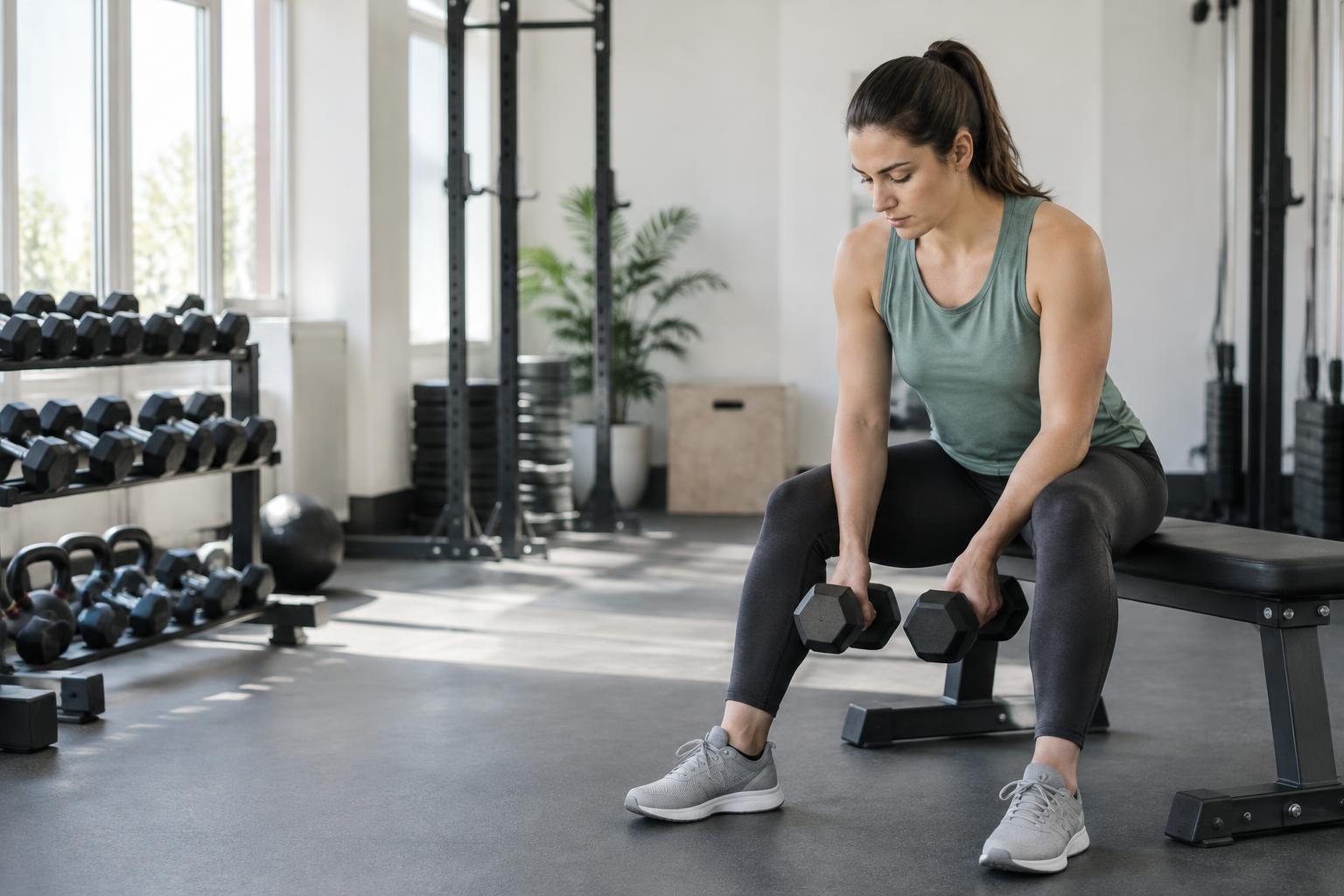
You've been showing up. Three, maybe four times a week, for months. You don't skip leg day, you sweat through every class, and yet the mirror looks the same and you're still lifting the same dumbbells you picked up in spring. At some point the question shifts from "how do I get better at this?" to "is any of this even working?"
It's a frustrating place to be, and it's one of the most common reasons people quit. The good news: when training doesn't seem to work, it's rarely because your body is "stubborn" or because you're doing something deeply wrong. It's usually a gap between what you're doing in the gym and what's happening the rest of the day, in your kitchen, in your bed, and on your calendar.
We dug into the research so you don't have to. Below we go through the six most common reasons women stop seeing progress, what the science says about each one, and the specific change to make. Each section stands on its own, so jump to the one that sounds most like you. At the end there's a simple way to put it all together into your week.
Working Out But Not Seeing Results? Check How You Measure First
Before changing anything, it helps to check whether you're measuring the right thing. A lot of "not seeing results" is really "not seeing results on the scale."
The scale is a noisy measure
Body weight moves for many reasons that have nothing to do with fat or muscle: how much salt you ate yesterday, how much water you drank, how much food is still in your gut, and where you are in your cycle. In a one-year study of 62 women and 765 menstrual cycles, self-reported fluid retention peaked on the first day of the period and was lowest in the mid-follicular phase (the days after your period ends) (White et al., 2011, Obstetrics and Gynecology International). If you weigh yourself the morning your period starts, you're often weighing water.
Strength usually moves first
When you start lifting, a lot of the early strength gain comes from your nervous system getting better at the movement, not only from bigger muscles. Changes in muscle size do start early. In one study of 47 previously untrained women doing squats and deadlifts twice a week, lean mass in the legs and hips increased measurably within three weeks (Stock et al., Human Movement Science). But "measurable in a lab" and "visible in the mirror" are not the same thing, and visible change usually takes a lot longer.
Better ways to track progress
| What to track | How often | Why it's useful |
|---|---|---|
| Weight and reps on 2-3 main lifts | Every session | The clearest sign your training is working |
| Waist, hips and thigh measurements | Every 2-4 weeks | Picks up changes the scale misses |
| Photos in the same light and outfit | Every 4 weeks | Shows shape changes over time |
| Scale weight | Optional; if you weigh, use a weekly average | Smooths out water and cycle swings |
| Energy, sleep and how workouts feel | Daily, takes seconds | Explains the weeks that feel off |
Reason 1: You've Been Lifting the Same Weights for Months
This is the most common reason we see, and the easiest to fix. Your muscles adapt to what you ask of them. Once a weight feels manageable, it stops being a reason to change.
What progressive overload means
Progressive overload simply means gradually asking more of your muscles over time: a bit more weight, a few more reps, or another set. The American College of Sports Medicine's position stand on resistance training progression recommends increasing the load by about 2-10% once you can do one or two reps more than your target on two sessions in a row, with smaller jumps for small muscles (like shoulders) and bigger jumps for large ones (like legs) (Ratamess et al., 2009, Medicine & Science in Sports & Exercise).
Why group classes can plateau
Many group classes are built for a full-body burn: lighter weights, lots of reps, little rest, and a different workout every time. That's great for conditioning and for showing up consistently. But if the weights never go up and the exercises keep changing, there's no clear way to add load to the same movement week after week, which is the main signal muscles need to keep adapting.
A simple way to add weight
Use a rep range instead of a fixed number. For beginners, the ACSM position stand suggests 8-12 reps per set at a moderate load. Here's how a "double progression" works in practice:
| Week | Goblet squat | What happened |
|---|---|---|
| 1 | 25 lb x 8, 8, 8 | Start at the bottom of the range |
| 2 | 25 lb x 10, 9, 9 | Add reps when you can |
| 3 | 25 lb x 12, 12, 11 | Almost at the top |
| 4 | 25 lb x 12, 12, 12 | Top of the range on all sets |
| 5 | 30 lb x 8, 8, 8 | Add weight, drop back to 8 reps, repeat |
The exact numbers matter less than the habit: write down what you lifted, and when you hit the top of your range with good form, go up.
Reason 2: You're Not Doing Enough Hard Sets per Muscle
Even with heavier weights, the total amount of work each muscle gets per week matters. This is often called weekly volume, and it's usually counted as the number of challenging sets per muscle group.
What the research says about sets
A 2016 meta-analysis of 15 studies found a graded relationship between weekly sets and muscle growth: fewer than 5 sets per muscle per week produced roughly 5% growth, 5-9 sets about 7%, and 10 or more sets about 10% (Schoenfeld, Ogborn and Krieger, Journal of Sports Sciences). The authors suggested at least 10 weekly sets per muscle group to maximize growth.
Two honest caveats. First, the difference between groups didn't quite reach statistical significance, and when one influential study was removed, the 5-9 and 10+ groups looked about the same. Second, the same authors note that even 4 or fewer weekly sets can produce meaningful gains, especially for beginners or anyone short on time.
What "hard sets" means
A set counts when it's genuinely challenging: you finish with only about 1-3 reps left in the tank. Ten sets where you could have done 10 more reps each aren't the same as ten sets close to your limit. This is also why logging how hard a set felt matters as much as logging the weight.
Where to start
- New to lifting or coming from classes: 4-6 hard sets per muscle group per week, spread over 2-3 full-body sessions
- Lifting consistently for 6+ months: work toward 8-12 hard sets per muscle group per week
- Always: add sets gradually, one or two per muscle per week at a time, and pull back if you're sore for days or dreading every session
Reason 3: You're Not Eating Enough Protein
Training is the signal to build muscle. Protein is part of the raw material. Many women who train eat far less protein than the research suggests is useful for building muscle.
How much protein you need to build muscle
A 2018 meta-analysis of 49 randomized controlled trials and 1,863 participants found that protein intakes above about 1.6 g per kg of body weight per day produced no further gains in fat-free mass from resistance training (Morton et al., British Journal of Sports Medicine). In other words, around 1.6 g/kg is a sensible daily target for most people trying to build muscle, and going far above it doesn't seem to add much.
That's roughly 0.7 g per pound of body weight:
| Body weight | Daily protein target (about 1.6 g/kg) |
|---|---|
| 120 lb (54 kg) | about 87 g |
| 140 lb (64 kg) | about 102 g |
| 160 lb (73 kg) | about 117 g |
| 180 lb (82 kg) | about 131 g |
These are starting estimates, not prescriptions. If you have kidney disease or another medical condition, check with your doctor before changing your protein intake.
Making it realistic
Hitting 100 g a day is hard if most of it comes at dinner. A practical approach many people use is to include a solid protein source at every meal:
- Breakfast: Greek yogurt, eggs or cottage cheese instead of a pastry or plain toast
- Lunch and dinner: a palm-to-hand-sized portion of chicken, fish, tofu, tempeh, lean beef or beans
- Snacks: a protein shake, edamame, jerky or cheese when meals fall short
Reason 4: You're Not Eating Enough, Period
This one is less obvious and more important. Many women who aren't seeing results respond by eating less and training more. That can backfire.
What happens when you underfuel
When the energy you eat doesn't cover what your body needs for both exercise and everyday functions, researchers call it low energy availability. The International Olympic Committee's 2023 consensus statement describes Relative Energy Deficiency in Sport (REDs) as a syndrome of harmful health and performance effects caused by low energy availability, in both women and men.
This isn't only an issue for elite athletes. In a survey of 109 female recreational exercisers recruited from gyms and fitness centers, 45% screened as at risk of low energy availability, and each extra hour of weekly exercise was linked to higher odds of being at risk (Slater et al., 2016, International Journal of Sport Nutrition and Exercise Metabolism). A screening questionnaire isn't a diagnosis, but it shows how common the pattern is among women who simply go to the gym.
Signs you might be underfueling
- You feel flat or exhausted in most workouts, not just occasionally
- Your strength has stalled or gone down despite training consistently
- You're often cold, irritable or thinking about food
- Your sleep has gotten worse
- Your periods have become irregular, lighter or have stopped
What to do
If several of these sound familiar, eating more (especially around training) is often part of the fix, not the problem. And if your period has stopped for three months or more, or has become very irregular, please see a doctor. That's a health signal worth taking seriously, not just a training issue.
Reason 5: You're Not Sleeping Enough
You can do everything right in the gym and in the kitchen and still not see results if your sleep is consistently short. Sleep affects both how well you train and how well you recover.
What the research says about sleep and performance
A 2022 meta-analysis of 77 studies found that acute sleep loss reduced exercise performance by about 7.6% on average (Craven et al., Sports Medicine). Two details matter for real life. Waking up earlier than usual (cutting sleep at the end of the night) hurt performance consistently, while going to bed later had less clear effects. And performance in afternoon and evening sessions was affected more than morning sessions, with performance dropping further for every hour you'd been awake.
Most participants in these studies were men, so the numbers for women are less certain. But the direction is consistent.
What sleep does to muscle repair
In a small study of 13 young adults (7 men, 6 women), one night without sleep reduced muscle protein synthesis, the process of building and repairing muscle, by 18% compared with a normal night. Cortisol was 21% higher and testosterone 24% lower across the following day (Lamon et al., 2021, Physiological Reports). This was a full night of no sleep, which is more extreme than most bad nights, and the study was too small to say whether women respond differently. Still, it shows why recovery suffers when sleep does.
What to do after a bad night
- One rough night: train, but consider lighter loads or fewer sets. Keep the habit, skip the personal record
- Several short nights in a row: swap a hard session for a walk or easy mobility work and protect bedtime that night
- Consistently under 7 hours: treat sleep as part of your training plan. A consistent wake time and a wind-down routine are often worth more than an extra workout
Reason 6: You're Blaming (or Ignoring) Your Cycle
Your cycle gets a lot of attention online, and many women feel stronger or weaker at different points in their cycle. So what does the research actually say?
What the research says about cycle phase and strength
A 2023 review of meta-analyses and systematic reviews concluded that the current evidence doesn't show a meaningful effect of menstrual cycle phase on strength performance or on long-term strength and muscle gains from resistance training (Colenso-Semple et al., Frontiers in Sports and Active Living). The authors also noted that many studies don't verify cycle phase well, so the evidence is weak in both directions. In plain words: there's no good evidence yet that you need to plan your whole program around your cycle phase.
Your symptoms are still real
None of this means your cycle doesn't matter to you. Cramps, poor sleep, low energy and bloating before or during your period can absolutely affect how a workout feels. Rather than following a one-size-fits-all cycle-syncing plan, a more useful approach is to notice your own pattern. If you log how your energy and workouts feel, you can see whether certain days are consistently harder for you and adjust on those days.
What to do
- Don't judge progress by the scale around the start of your period (see the fluid retention data above)
- On days with symptoms, it's fine to lower the weight, cut a set or swap to lighter work
- Keep training through your cycle if you feel up to it; there's no evidence you need to stop
- If your periods are very painful, very heavy or irregular, talk to a doctor
Put It Together: Your Week
The six reasons above rarely show up one at a time. A short night leads to a flat workout, a flat workout leads to skipping the last sets, and a stressful day leads to skipping lunch and eating little protein. That's why looking at training alone often misses the real cause. Here's a simple way to connect the pieces.
A starting week for most women
This assumes three sessions per week and roughly 45-60 minutes each.
| Day | Training | Food focus | Recovery |
|---|---|---|---|
| Monday | Full body A: squat, row, push-up, hip thrust (3 sets each, 8-12 reps) | Protein at all 3 meals | Aim for your normal bedtime |
| Tuesday | 20-40 min walk | Protein-forward breakfast | Note sleep and energy |
| Wednesday | Full body B: Romanian deadlift, lat pulldown, dumbbell press, lunges | A meal or snack with carbs 1-3 hours before training | Check how sore you are |
| Thursday | Rest or easy mobility | Normal eating, no "making up" for anything | Protect sleep |
| Friday | Full body A again, try to add reps or weight | Protein at all 3 meals | Note energy |
| Weekend | Something active you enjoy | Flexible, keep protein in | Catch up on rest if needed |
Your daily decision guide
| If today... | Then... |
|---|---|
| You slept well and feel good | Train as planned; try to add a rep or a little weight |
| You slept under 6 hours | Train, but keep weights the same and skip the hardest set |
| You've had several short nights | Swap to a walk or mobility; prioritize bedtime |
| It's day 1-2 of your period and you feel rough | Lighter weights or fewer sets; skip the scale |
| You hit the top of your rep range on all sets | Add weight next session |
| Your lifts have dropped two weeks in a row | Check sleep and food first, then consider an easier week |
| You've barely eaten today | Eat before training rather than training on empty |
Review every 4 weeks
Once a month, look back at your lifts, measurements and notes. If your main lifts are going up, you're making progress, even if the scale hasn't moved. If nothing has changed in four weeks, go back through the six reasons and pick the one that fits your notes best. Change one thing at a time so you know what worked.
FAQ
Why am I working out but not losing weight?
Weight can stay the same while your body composition changes, and daily weight swings with water, salt, food volume and your cycle. Track measurements, photos and strength alongside a weekly average of your weight. If none of those have changed in 4-6 weeks, look at your food intake with a qualified professional rather than just training more.
How long does it take to see results from working out?
Strength often improves within the first few weeks as you learn the movements. Measurable changes in muscle size can begin within weeks in beginners, but visible changes usually take longer. Consistency over several months, with gradual increases in weight, matters more than any single week.
Should I gain weight when I start working out?
Some short-term weight gain is common and is often water stored with carbohydrate in your muscles or fluid from recovering muscles. It isn't a sign you're "getting bulky." Judge changes over several weeks using measurements and photos, not day-to-day scale readings.
Can you build muscle if you don't eat enough protein?
You can still make some progress, especially as a beginner, but low protein can limit how much muscle you build. Research suggests benefits up to around 1.6 g of protein per kg of body weight per day (about 0.7 g per lb). Spreading it across meals makes the target much easier to hit.
Does a bad night's sleep ruin my workout?
One bad night usually won't ruin a workout, but research shows sleep loss reduces performance on average, especially when you wake up earlier than usual and train later in the day. On those days, keep the session but go a bit lighter. If short nights are frequent, improving sleep is likely to help your progress more than pushing through.
Should I train differently on my period?
Current research doesn't show that cycle phase meaningfully changes strength or muscle gain, so there's no need to stop training. If you have cramps, fatigue or poor sleep, it's fine to lighten the load or cut a set on those days. See a doctor if your periods are very painful, very heavy or irregular.
Conclusion
If you're working out but not seeing results, you're not failing and your body isn't broken. In most cases, a few specific gaps are holding you back: weights that haven't changed in months, too few hard sets, too little protein or food overall, short sleep, or a scale that's measuring water instead of progress.
The fix is rarely a brand-new program. It's adding weight in small steps, eating enough protein, protecting your sleep, and paying attention to how your week actually goes. Track your lifts, keep simple notes on food, sleep and energy, and review every four weeks. Change one thing at a time. Progress that's built this way tends to stick, because it fits the week you actually have.
This article is for general education and isn't medical advice.
If you want help putting this into your own week, Wellio is an AI coach that sees the whole picture: it builds your plan around your workouts, meals, sleep and energy, logs your sets so it can suggest when to add weight, and guides you day by day as life changes. Join the Wellio waitlist.
Sources
- Colenso-Semple LM, et al. Current evidence shows no influence of women's menstrual cycle phase on acute strength performance or adaptations to resistance exercise training. Frontiers in Sports and Active Living, 2023.
- Craven J, et al. Effects of acute sleep loss on physical performance: a systematic and meta-analytical review. Sports Medicine, 2022.
- Lamon S, et al. The effect of acute sleep deprivation on skeletal muscle protein synthesis and the hormonal environment. Physiological Reports, 2021.
- Morton RW, et al. A systematic review, meta-analysis and meta-regression of the effect of protein supplementation on resistance training-induced gains in muscle mass and strength in healthy adults. British Journal of Sports Medicine, 2018.
- 2023 International Olympic Committee's (IOC) consensus statement on Relative Energy Deficiency in Sport (REDs). British Journal of Sports Medicine, 2023.
- Ratamess NA, et al. Progression models in resistance training for healthy adults (ACSM position stand). Medicine & Science in Sports & Exercise, 2009.
- Schoenfeld BJ, Ogborn D, Krieger JW. Dose-response relationship between weekly resistance training volume and increases in muscle mass. Journal of Sports Sciences, 2016.
- Slater J, et al. Female recreational exercisers at risk for low energy availability. International Journal of Sport Nutrition and Exercise Metabolism, 2016.
- Stock MS, et al. Evidence of muscular adaptations within four weeks of barbell training in women. Human Movement Science.
- White CP, et al. Fluid retention over the menstrual cycle: 1-year data from the prospective ovulation cohort. Obstetrics and Gynecology International, 2011.