How to Start Lifting
Weights at the GymWhen You're Used to Group Classes
Same 5 lb dumbbells for months? Here are the six moves to learn, a simple four-week plan, and how to choose your weights when no instructor is calling the reps.
 By Wellio
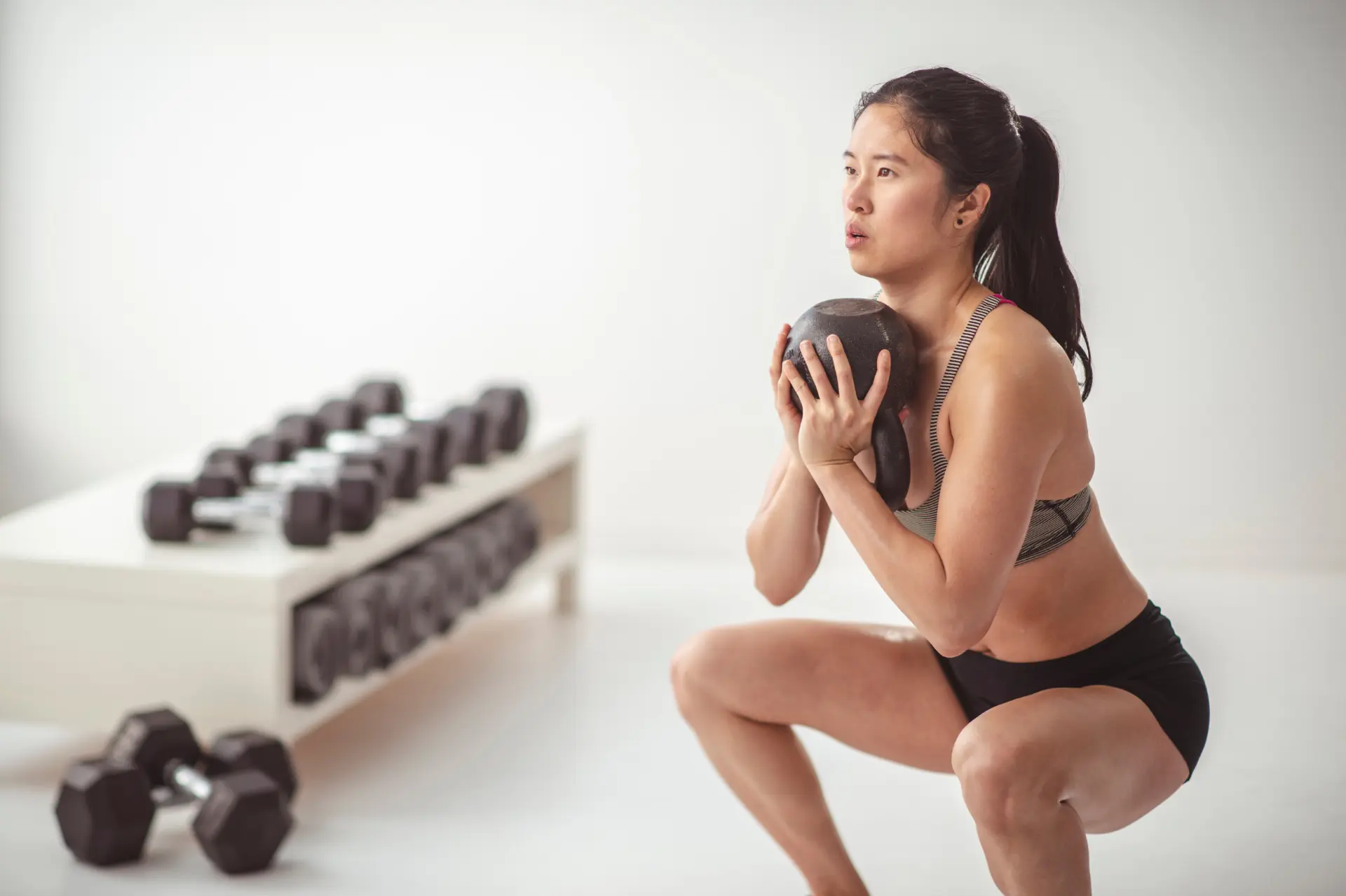
You've been doing group classes for a while. You know your way around a step, a spin bike or a set of 5 lb dumbbells, and you show up consistently. But your body hasn't really changed in months, someone told you to "lift heavier," and now you're standing at the edge of the weights area with no idea what to do or where to start.
That gap is completely normal. Classes are designed so someone else does the thinking: the instructor picks the exercises, the weight, the reps and the timing. Lifting on your own hands all of that to you, and nobody explains how. Most beginner guides either drown you in jargon or give you a random workout with no plan for what happens next week.
We built this guide for that exact moment. We used the new 2026 resistance training guidelines from the American College of Sports Medicine (ACSM), its first major update in 17 years, plus the most common questions women ask when they make this switch. Below you'll find what's actually different about lifting, the six movements to learn first, a four-week beginner plan, how to choose your weights and progress, how to feel less awkward in the gym, and how to fit your favorite classes around it all.
Group classes vs lifting on your own: what actually changes
This block explains why classes alone often stop producing results, and what lifting does differently.
Group classes aren't bad. They're fun, social and great for fitness and consistency. But they're usually built for a sweaty, varied hour, not for steadily building strength. Here's how the two compare:
| Typical group class | Lifting on your own | |
|---|---|---|
| Who decides | The instructor | You (or your plan) |
| Weights | Light, so everyone can keep up | Chosen to challenge you |
| Reps | Often high (20+) or timed | Usually fewer, harder reps |
| Exercises | Change every session | Repeat for weeks so you can measure progress |
| Rest | Short or none | Enough to do the next set well |
| Progress | Hard to track | Written down and increased over time |
The biggest difference is the last row. Muscles get stronger when you gradually ask more of them over time. The 2026 ACSM position stand describes the basics simply: train consistently and increase weight or reps over time. In a class where the workout changes every day and the dumbbells stay the same, that steady increase rarely happens.
How much lifting do you actually need?
Good news: the minimum is less than most people think. This block covers what the guidelines recommend.
The US Physical Activity Guidelines recommend muscle-strengthening activity at least 2 days a week, working the legs, hips, back, abdomen, chest, shoulders and arms.
The 2026 ACSM position stand, based on 137 systematic reviews covering more than 30,000 participants, adds more detail:
- Train all major muscle groups at least twice a week.
- For strength, 2 to 3 sets per exercise with heavier loads (around 80% of your one-rep max) are effective.
- For muscle growth, about 10 sets per muscle group per week is a good target, and a wide range of weights works as long as sets are challenging.
- Training to complete failure, using machines vs free weights, and complicated programming did not consistently change results for average healthy adults.
- The program you'll actually stick with is the best one. The guidelines emphasize goals, enjoyment and safety.
The point about a wide range of weights is backed by earlier research too. A 2017 meta-analysis in the Journal of Strength and Conditioning Research by Schoenfeld and colleagues (21 studies, mostly untrained people) found that lighter and heavier weights built similar amounts of muscle when sets were taken to failure, while heavier weights built more maximal strength. So the light dumbbells from class can build muscle if the sets are genuinely hard, but heavier weights are the faster route to getting stronger.
The lead author, Stuart Phillips, put it plainly: "The best resistance training program is the one you'll actually stick with."
The 6 movements to learn first
This block gives you the building blocks for almost every beginner program. Learn these and you can follow nearly any plan.
| Movement | What it trains | Beginner version | Next step when it feels easy |
|---|---|---|---|
| Squat | Legs, glutes, core | Goblet squat (holding one dumbbell at your chest) | Heavier goblet squat, then barbell or Smith machine squat |
| Hinge | Glutes, hamstrings, back | Dumbbell Romanian deadlift | Heavier dumbbells, then barbell Romanian deadlift |
| Push | Chest, shoulders, arms | Incline dumbbell press or machine chest press | Flat dumbbell press, push-ups from the floor |
| Pull | Back, arms | Seated cable row or lat pulldown | Single-arm dumbbell row, assisted pull-ups |
| Single-leg | Legs, glutes, balance | Step-up onto a low box or split squat holding a support | Reverse lunges, Bulgarian split squats |
| Carry or core | Core, grip, posture | Farmer's carry (walk holding two dumbbells) | Heavier carries, plank variations |
You'll recognize some of these from classes. The difference now is doing them slower, with more control and heavier weights.
How to learn them
- Watch a short video before your session for each move you plan to do. Look for coaches who show the movement from the side and front.
- Start with a light weight for your first set and focus on how the movement feels.
- Film a set on your phone and compare it to the video. It's the fastest way to spot problems.
- Book a gym orientation or one session with a trainer if your gym offers it. One hour of coaching on these six moves goes a long way.
How to start lifting weights at the gym: your first 4 weeks
Here's a simple plan built on the guidelines above. It uses two full-body workouts, A and B, that you alternate. The specific sets and reps are common beginner coaching choices that fit the ACSM recommendations.
Workout A
| Exercise | Sets | Reps |
|---|---|---|
| Goblet squat | 3 | 8 to 12 |
| Incline dumbbell press | 3 | 8 to 12 |
| Seated cable row | 3 | 10 to 12 |
| Dumbbell Romanian deadlift | 2 | 10 to 12 |
| Farmer's carry | 2 | 30 to 40 seconds |
Workout B
| Exercise | Sets | Reps |
|---|---|---|
| Dumbbell Romanian deadlift | 3 | 8 to 12 |
| Lat pulldown | 3 | 10 to 12 |
| Step-ups or split squats | 2 | 8 to 10 per leg |
| Machine chest press or push-ups | 3 | 8 to 12 |
| Plank | 2 | 20 to 40 seconds |
How to schedule it
- 2 days a week: Workout A on Monday, Workout B on Thursday.
- 3 days a week: Alternate A, B, A one week and B, A, B the next, with at least one rest day between sessions.
Warm up for 5 to 10 minutes first: easy cardio plus one light set of your first exercise. Rest about 1 to 2 minutes between sets. Each session should take 40 to 60 minutes.
Stick with the same plan for at least four weeks. It will feel repetitive compared with classes, but that repetition is exactly what lets you see progress.
How much weight should you lift as a beginner?
This is the question almost every beginner asks, and there's no single number. Here's how to find yours.
Step 1: Start lighter than you think
On your first session, pick a weight you're confident you can lift 12 times with good form. It's fine if it feels easy. You're learning the movement and finding a baseline.
Step 2: Use the "reps left" test
After each set, ask: how many more reps could I have done with good form? Many coaches recommend finishing most sets with about 2 to 3 reps left in the tank. That's hard enough to drive progress without grinding to failure, which the ACSM guidelines found unnecessary for most people.
| After your set, you could have done... | What to do next set |
|---|---|
| 5 or more extra reps | Go heavier |
| 2 to 3 extra reps | Keep this weight |
| 0 to 1 extra reps, or your form broke down | Go a little lighter |
Step 3: Write it down
Note the exercise, weight and reps for every set. Next session, start from those numbers instead of guessing. This one habit is what turns workouts into a plan.
Expect to go up quickly at first. In the first few weeks, much of your improvement comes from getting better at the movement itself, so the weights may climb faster than you expect.
How to make progress (progressive overload for beginners)
This block explains how to keep getting stronger once you've found your starting weights.
A simple, widely used method is double progression:
- Pick a rep range, like 8 to 12.
- Use the same weight until you can do the top of the range (12 reps) on all your sets with good form.
- Then increase the weight slightly, which usually drops you back toward 8 reps.
- Build back up to 12, and repeat.
For dumbbells, the next step up is usually 2.5 to 5 lb. For lower-body exercises you'll often move up faster than for upper-body ones. If a jump feels too big, add a rep or two before adding weight.
Signs you're progressing (even when the weight doesn't change)
- More reps at the same weight
- Better control and range of motion
- Less effort for the same set
- Shorter rest needed between sets
Free weights vs machines: which should you use first?
Beginners often worry they're doing it "wrong" by using machines. You're not.
The 2026 ACSM position stand found that choosing machines or free weights did not consistently change strength or muscle results for average healthy adults. Both work. They just have different strengths:
| Machines | Free weights (dumbbells, barbells, kettlebells) | |
|---|---|---|
| Learning curve | Easy, the path is set for you | Takes more practice |
| Good for | Building confidence, isolating muscles, training safely alone | Balance, coordination, training at home |
| Adjusting weight | Move a pin | Swap dumbbells or plates |
| Downside | Can be busy at peak times; fit varies by body size | Technique matters more |
A practical mix for beginners: use free weights for squats, hinges and carries, and machines or cables for pulling and pressing until you feel confident.
How to feel confident in the weights section
Feeling awkward in the weights area is one of the most common reasons women stay in classes. This block is your first-visit checklist.
Before you go
- Write your workout on your phone, including exercises, sets, reps and starting weights. No wandering around wondering what's next.
- Go at a quieter time for your first few sessions, like mid-morning or early afternoon.
- Have a backup exercise for anything that might be busy (for example, dumbbell rows if the cable row is taken).
At the gym
- Claim a small corner. Grab a bench and the dumbbells you need and stay there for most of the session.
- It's fine to ask to share. "How many sets do you have left?" or "Can I work in?" are normal gym phrases.
- Re-rack your weights and wipe down equipment. That's most of gym etiquette.
- Put your headphones in. It helps you focus and signals you're busy.
Keep perspective
Most people in the weights area are focused on their own workout. And everyone there started as a beginner. If someone offers unsolicited advice, you can say thanks and decide later whether it's useful.
Can you keep doing group classes?
Yes. You don't have to give up the classes you love. This block shows how to fit them in.
A common, balanced week for someone switching over:
| Day | Option |
|---|---|
| Monday | Lifting: Workout A |
| Tuesday | Class you enjoy (spin, dance, yoga) |
| Wednesday | Rest or a walk |
| Thursday | Lifting: Workout B |
| Friday | Class |
| Weekend | One optional lifting session, or rest and something active you enjoy |
A few tips (these are common coaching suggestions, not hard rules):
- Avoid a leg-heavy class the day before a lifting session with squats and deadlifts, if you can.
- If a class has its own weights section, treat that as conditioning and keep your real strength work in your lifting sessions.
- Keep at least one full rest day each week.
Common beginner mistakes to avoid
- Changing the workout every session. You can't measure progress if the exercises keep changing.
- Lifting too light for too long. If you could do 10 more reps, the set isn't doing much.
- Lifting too heavy, too soon. If your form breaks down, lower the weight.
- Not writing anything down. Without a log, you're guessing every session.
- Skipping the warm-up. A few minutes of easy movement and a light first set make the rest of the session better.
- Doing an hour of cardio first. If strength is your priority, lift first and do cardio after or on another day.
- Judging progress by the scale alone. Strength, measurements and how your clothes fit often change before the scale does.
If you feel sharp pain (not normal muscle effort), stop that exercise. If pain continues, or if you're pregnant, postpartum, or managing an injury or medical condition, check with a doctor or physio before starting.
Put it together: your week
Lifting is one part of your progress. Food, sleep and energy shape how well your training works. Here's how to connect them.
Food
Protein supports muscle repair and growth. The International Society of Sports Nutrition's position stand suggests 1.4 to 2.0 g of protein per kg of body weight per day for most people who exercise, in servings of about 20 to 40 g. For a 150 lb (68 kg) woman, that's roughly 95 to 135 g a day. Treat it as a starting estimate, not a strict target. A simple approach is to include a solid protein source at each meal: eggs, Greek yogurt, chicken, fish, tofu, beans or lentils.
Eat something before your session if you train after a long gap without food. A tired, underfed body lifts poorly.
Sleep and energy
Sleep affects how heavy your workout feels. On a bad night, keep your lifts but go a little lighter and skip personal records. On a great day, that's when to push for an extra rep.
A sample week
- Monday: Workout A. Protein-rich dinner. Log your weights.
- Tuesday: Class you enjoy.
- Wednesday: Rest. Short walk. Early night if you can.
- Thursday: Workout B. Check Monday's notes, add a rep where you hit the top of the range.
- Friday: Class, or rest if you're tired.
- Weekend: Optional third lifting session, or rest and something active.
After four weeks, look back at your log. You'll likely see higher weights or more reps on most exercises, which is the clearest sign the switch is working.
Frequently asked questions
How do I start lifting weights at the gym as a complete beginner?
Start with two full-body sessions a week built on six movements: a squat, a hinge, a push, a pull, a single-leg move and a carry. Do 2 to 3 sets of 8 to 12 reps with a weight that leaves about 2 to 3 reps in reserve, and write everything down so you can add weight or reps over time.
How many days a week should a beginner lift?
Two to three days. The US Physical Activity Guidelines and the 2026 ACSM position stand both recommend training all major muscle groups at least twice a week. Two full-body sessions is plenty to start, and you can add a third once it feels manageable.
Will lifting weights make me bulky?
Building noticeable muscle takes consistent training and eating over a long time, so it doesn't happen by accident in a few weeks. What most beginners notice first is getting stronger and feeling firmer. You can always adjust your training if you change your goals.
Should beginners use machines or free weights?
Either works. The 2026 ACSM guidelines found machines and free weights produced similar results for average healthy adults. Many beginners use machines and cables for pressing and pulling, and dumbbells for squats, hinges and carries.
How heavy should I lift as a beginner?
Pick a weight you can lift for your target reps with good form and about 2 to 3 reps left in the tank. If you could do five or more extra reps, go heavier. If your form breaks down, go lighter.
Can I still do group classes if I start lifting?
Yes. Two lifting sessions plus one or two classes a week is a sustainable mix. Try not to schedule a leg-heavy class the day before your squat and deadlift day, and keep at least one rest day.
Conclusion
Moving from group classes to lifting on your own feels like a big leap, but the plan is simpler than it looks. Train your whole body two or three times a week, learn six basic movements, pick weights that challenge you, write everything down, and add a little weight or a rep or two when it gets easier. That's what the newest guidelines support, and it's what turns "same weights for months" into steady progress.
You can keep the classes you love. Just give your lifting sessions a consistent plan, support them with enough protein and sleep, and give it at least four weeks before you judge the results.
This article is for general education and isn't medical advice.
If you want help putting this into your own week, Wellio is an AI coach that sees the whole picture: it builds your plan around your workouts, meals, sleep and energy, and guides you day by day as life changes. Answer a few questions about your goal, schedule and equipment to get a starting plan, log your sets as you go, and get suggestions for when to add weight. Join the Wellio waitlist.
Sources
- American College of Sports Medicine. ACSM releases new position stand on resistance training (Resistance Training Prescription for Muscle Function, Hypertrophy, and Physical Performance in Healthy Adults: An Overview of Reviews. Medicine & Science in Sports & Exercise, April 2026).acsm.org
- ACSM press release via Newswise. ACSM Unveils Landmark 2026 Resistance Training Guidelines. March 2026.newswise.com
- Centers for Disease Control and Prevention. Physical Activity Guidelines for Adults.cdc.gov
- Schoenfeld BJ, Grgic J, Ogborn D, Krieger JW. Strength and hypertrophy adaptations between low- vs. high-load resistance training: a systematic review and meta-analysis. Journal of Strength and Conditioning Research, 2017 (summary by the Canadian Kinesiology Alliance).cka.ca
- Jäger R, et al. International Society of Sports Nutrition Position Stand: protein and exercise. Journal of the International Society of Sports Nutrition, 2017.cdr.lib.unc.edu
Make it work
for your week.